笑
Character Story & Explanation
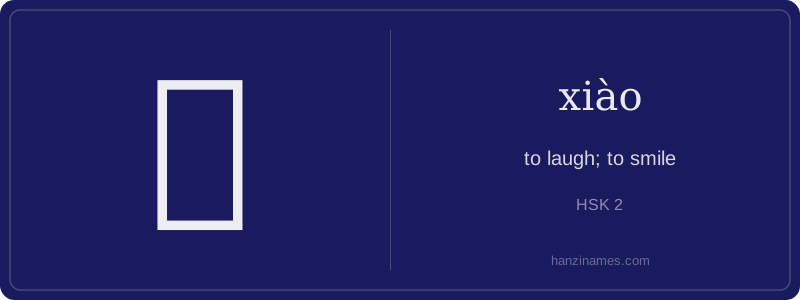
笑 is ubiquitous in modern Chinese life: from emoji-laden WeChat messages (→‘笑死了’—‘laughed to death’, meaning ‘hilarious’) to formal idioms like 哄堂大笑 (hōng táng dà xiào—‘roaring laughter filling the hall’), used in speeches and literature since at least the Song dynasty (10th–13th c.). It appears in the classic idiom 谈笑风生 (tán xiào fēng shēng—‘conversing and laughing with lively charm’), describing charismatic, effortless eloquence—still widely cited in media and education.
The character’s form evolved from seal script (c. 221 BCE), where it combined ⺮ (bamboo, top) and 夭 (yāo, ‘bent figure’, bottom)—not a pictograph of laughter, but a phonosemantic compound: ⺮ hints at lightness (bamboo bends but doesn’t break), and 夭 provides sound and conveys ‘youthful vitality’. No oracle-bone inscription of 笑 exists; its earliest confirmed form is in Han-era bamboo slips (206 BCE–220 CE), consistently used for joyful expression.
The Chinese character 笑 (xiào) conveys the universal human expression of joy—laughing or smiling—but carries nuanced cultural weight. Unlike English, where 'laugh' and 'smile' are distinct verbs with different emotional registers (e.g., a nervous laugh vs. a polite smile), 笑 encompasses both, often implying warmth, friendliness, or social harmony. It rarely suggests mockery unless paired with context or modifiers—unlike English ‘laugh at’, which can be inherently derisive.
In Chinese communication, 笑 frequently softens statements, signals humility, or defuses tension—such as laughing off criticism (‘笑一笑,十年少’—‘Laugh once, and ten years fall off your age’). This reflects Confucian ideals valuing emotional restraint and relational harmony over individual emotional display. A forced or inappropriate 笑 may even raise suspicion, whereas in Western contexts, smiling is often expected as default politeness.
Western equivalents like ‘smile’ (a facial gesture) or ‘laugh’ (a vocalized reaction) emphasize physical behavior or sound, while 笑 prioritizes the *intention* and *social function*: it’s less about muscle movement and more about relational alignment. For example, in customer service, staff may 笑 to show respect—not because they’re amused, but to affirm connection. This functional, context-sensitive use makes 笑 richer—and trickier—for learners than simple lexical equivalents suggest.
Example Sentences
Common Compounds
Similar Characters — Don't Mix These Up
Your First Step into Chinese Culture: Get a Chinese Name
Every journey into Chinese begins with a name. Use our free Chinese name generator to create a meaningful, personalized Chinese name that fits you perfectly.
Get My Chinese Name →