劬
Character Story & Explanation
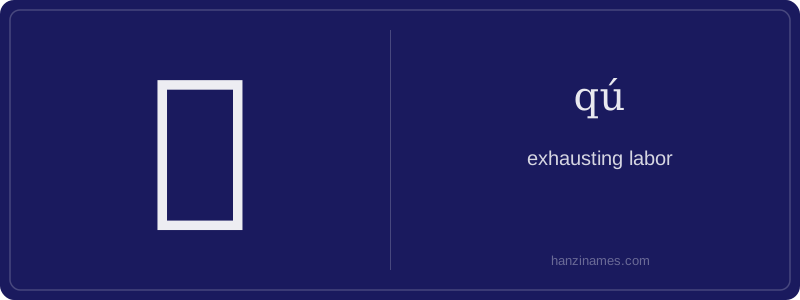
劬 is virtually unused in daily speech and does not appear in any HSK vocabulary list (HSK Level: Not assigned). It occurs almost exclusively in literary, historical, or rhetorical contexts — notably in classical poetry, official documents honoring public service, and idiomatic compounds like 劳劬 (láo qú, 'toiling labor') and 疲劬 (pí qú, 'exhausting toil'). The *Book of Songs* (c. 11th–7th c. BCE) uses 劬 in Ode 247 to praise maternal devotion: '哀哀父母,生我劬劳' ('Alas, my parents — they bore me in toil and hardship').
The character’s form combines 力 (‘strength’, radical) and 句 (originally phonetic; no pictographic origin). There is no oracle bone or bronze script pictograph showing a person laboring — instead, it evolved as a phono-semantic compound during the Warring States period. Today, Chinese learners encounter it only when reading classical texts or studying advanced vocabulary for exams like the Gaokao or civil service tests.
Our detective work begins with the radical 力 (lì) — 'strength' or 'effort' — anchoring 劬 firmly in the semantic field of physical exertion. This radical appears on the right, suggesting the character’s core idea is action-driven labor, not abstract toil. The left component, 句 (jù), originally a phonetic hint (though pronunciation diverged), once approximated the sound *qú* in Old Chinese. Unlike many characters where phonetics decayed completely, 句 here preserves a traceable acoustic lineage — a clue our detective notes but doesn’t overinterpret.
Zooming in on historical inscriptions: 劬 appears earliest in bronze inscriptions and classical texts like the *Book of Songs* (Shījīng), always paired with words denoting sustained, often wearying effort — especially by rulers, ministers, or parents. Its tone is solemn, respectful, never casual. It never meant 'work' as in a job (that’s 工 or 作), but rather ‘exhaustive, devoted labor’ — the kind that leaves one breathless and honored. This nuance is critical: 劬 carries moral weight, not just physical description.
Modern usage confirms this gravity: 劬 is nearly absent in spoken Mandarin and rare even in formal writing outside literary, academic, or ceremonial contexts. It survives not as a standalone word but as a fossilized morpheme — preserved in fixed compounds like 劳劬 (láo qú) or 疲劬 (pí qú), where it intensifies the sense of weariness. Our detective concludes: 劬 isn’t a living verb, but a lexical artifact — a dignified relic encoding Confucian ideals of sacrificial diligence, still legible to readers of classical poetry or official commendations.
Example Sentences
Common Compounds
Similar Characters — Don't Mix These Up
Your First Step into Chinese Culture: Get a Chinese Name
Every journey into Chinese begins with a name. Use our free Chinese name generator to create a meaningful, personalized Chinese name that fits you perfectly.
Get My Chinese Name →