劼
Character Story & Explanation
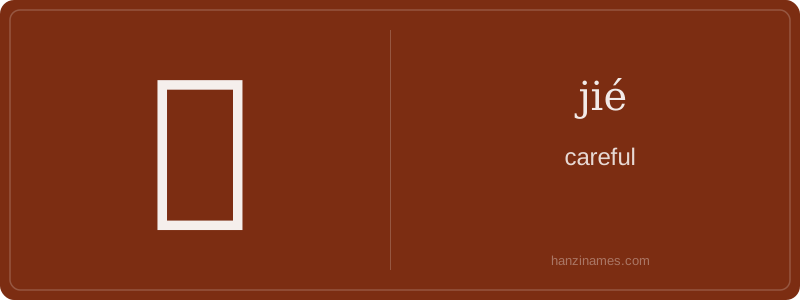
劼 appears infrequently in contemporary daily speech but persists in formal contexts: academic titles (e.g., 劼慎之士, 'a cautious and upright scholar'), historical biographies, and classical-style poetry. It features in the Shuōwén Jiězì (c. 100 CE), China’s earliest dictionary, defined as 'cautious and diligent' (小心而勤勉). Though no longer in HSK or modern textbooks, it survives in compound words like 勤劼 and in personal names—especially among older generations valuing scholarly virtue.
The character is not pictographic; it evolved from seal script where the left component (吉) means 'auspicious' and the right (力) means 'strength'. Together, they suggest 'strength grounded in auspicious intention'—a documented semantic compound, not a pictorial depiction. Today, Chinese learners encounter it mainly in classical reading or calligraphy practice, not in shopping or texting.
劼 (jié) is a relatively rare but elegant Chinese character meaning 'careful', 'cautious', or 'diligent'. Unlike common synonyms like 小心 (xiǎo xīn) or 认真 (rèn zhēn), 劼 carries a classical, literary tone—often appearing in formal writing, historical texts, or personal names. Its eight-stroke structure centers on the 力 (lì, 'strength' or 'effort') radical, suggesting that carefulness arises from intentional, disciplined exertion—not passive wariness.
This character reflects a Confucian ideal: moral and intellectual rigor as active cultivation, not mere avoidance of error. In classical usage, it often describes rulers or scholars who govern or study with meticulous restraint. Modern speakers rarely use it conversationally, but it endures in idioms like 勤劼 (qín jié, 'diligent and cautious'), reinforcing that diligence without prudence is incomplete.
Western equivalents like 'prudent' (Latin *prudens*, 'foreseeing') or 'scrupulous' (from Latin *scrupulus*, 'a small sharp stone') emphasize moral vigilance—but 劓 roots caution in embodied effort. While 'vigilant' implies watchfulness, 劼 implies sustained, strength-backed attentiveness—closer to the Stoic ideal of disciplined self-mastery than to modern psychological concepts of anxiety or risk-aversion.
Example Sentences
Common Compounds
Similar Characters — Don't Mix These Up
Your First Step into Chinese Culture: Get a Chinese Name
Every journey into Chinese begins with a name. Use our free Chinese name generator to create a meaningful, personalized Chinese name that fits you perfectly.
Get My Chinese Name →