笔
Character Story & Explanation
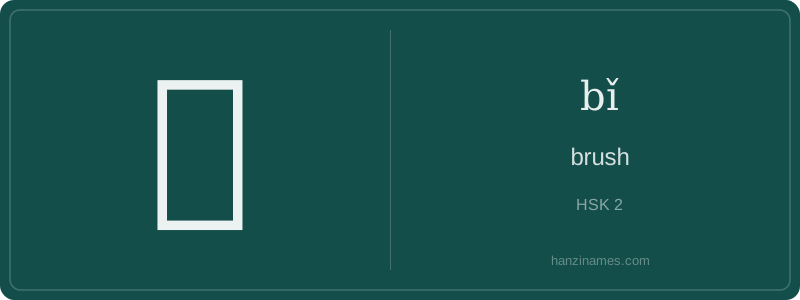
In daily life, 笔 is ubiquitous: students carry 笔袋 (bǐdài, pencil cases), office workers click ballpoints labeled ‘中性笔’ (zhōngxìngbǐ, gel ink pen), and calligraphers still refer to the ‘Four Treasures of the Study’—brush (笔), ink (墨), paper (纸), and inkstone (砚). The idiom 一笔勾销 (yī bǐ gōuxiāo, 'cancel with one stroke') originates from Qing-era accounting practices, where officials erased debts with a single brushstroke.
The character’s documented origin is pictographic-convergent: seal script 笔 unmistakably merges ⺮ (bamboo) and 毛 (hair), reflecting the actual construction of early Chinese brushes—bamboo handles bound with animal hair. Archaeological finds from Mawangdui (2nd c. BCE) confirm this design, validating the character’s material fidelity.
As a detective tracing 笔’s evolution, I begin with its earliest confirmed form: the seal script (c. 3rd century BCE), where it clearly combines ⺮ (bamboo radical) and 毛 (hair)—a literal depiction of a traditional brush: bamboo shaft + animal-hair tip. This wasn’t abstract symbolism—it reflected actual Han dynasty craftsmanship, when brushes were standardized under imperial workshops. The structure is purposeful, not decorative: every stroke encodes material reality.
By the Han dynasty, 笔 had shed earlier variant forms (like the rare bronze-inscription version with extra dots) and stabilized into its modern shape. Unlike characters that drifted semantically, 笔 retained its core meaning—'writing tool'—across two millennia. Even as inkstones, paper, and pens evolved, the character remained anchored to the act of inscription itself, not just the physical object. Its semantic consistency is unusually robust among HSK-2 characters.
The ten-stroke composition reveals careful balance: six strokes for ⺮ (the top bamboo radical, written as two parallel 'hats' over two short verticals), and four for 毛 beneath—mirroring how a brush is assembled: rigid support (bamboo) topped by pliable function (hair). No stroke is superfluous; even the final dot in 毛 represents the brush tip’s taper. This functional precision makes 笔 a masterclass in Chinese character engineering—form follows craft.
Example Sentences
Common Compounds
Similar Characters — Don't Mix These Up
Your First Step into Chinese Culture: Get a Chinese Name
Every journey into Chinese begins with a name. Use our free Chinese name generator to create a meaningful, personalized Chinese name that fits you perfectly.
Get My Chinese Name →