匈
Character Story & Explanation
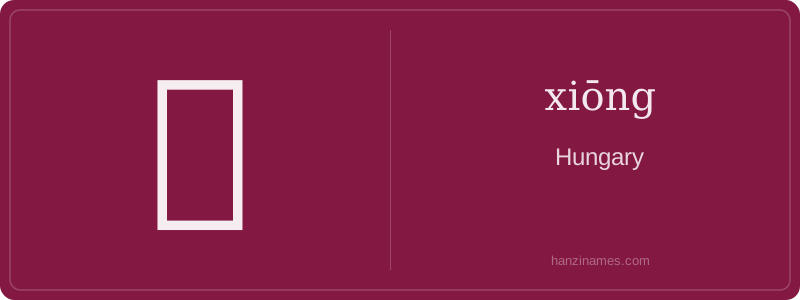
匈 appears exclusively in the fixed proper noun 匈牙利 (Xiōngyálì), the official PRC and ROC designation for Hungary, standardized in the early 20th century by the Commission on the Unification of Pronunciation and later codified in dictionaries like the 《现代汉语词典》. It is never used independently in speech or writing—no idioms, verbs, or adjectives contain 匈 outside this compound. Government documents, news media (e.g., Xinhua reports on EU summits), and textbooks consistently use 匈牙利; no alternative transcription exists in standard Mandarin.
The character 匈 originated as a variant of 胸 (xiōng, 'chest'), sharing the same pronunciation and radical 勹. In ancient texts like the 《说文解字》, 匈 was listed as an alternate form meaning 'chest' or 'breast', but this usage vanished by the Tang dynasty. Today, Chinese learners encounter it solely as part of the country name—e.g., when reading about Hungary’s participation in the Belt and Road Initiative or its EU membership status.
The Chinese character 匈 (xiōng) is a phonetic-semantic compound used almost exclusively in the modern context to transcribe the foreign country name 'Hungary'. Unlike most Chinese characters with rich semantic histories, 匈 carries no native meaning in classical or modern Chinese—it functions purely as a sound-based loan character. Its pronunciation xiōng approximates the first syllable of 'Hungary' (pronounced /ˈhʌŋɡəri/ in English, closer to 'Xiong-ga-li' in Mandarin transliteration).
This reflects a broader linguistic strategy in Chinese: using existing characters with similar sounds—not meanings—to render foreign names. For example, 德 (dé) for 'Germany' and 法 (fǎ) for 'France' follow the same principle. 匈 appears only in the compound 匈牙利 (Xiōngyálì), the official Mandarin name for Hungary—never alone in native vocabulary. Its radical 勹 (bāo), meaning 'to wrap', contributes no semantic relevance here; it’s retained from the character’s historical form but plays no role in its modern usage.
Compared to Western equivalents like 'Hungary'—a name rooted in medieval Latin 'Hungaria', derived from the tribal name 'Huns'—the Chinese term 匈牙利 is entirely phonetic and culturally neutral. While English speakers associate 'Hungary' with Central European geography and history, Chinese readers see 匈牙利 as a standardized, bureaucratic toponym, much like how 'USA' is written as 美国 (Měiguó, 'beautiful country')—a meaningful yet arbitrary calque. This highlights how Chinese handles foreign concepts: through sound-matching first, meaning second—or not at all.
Example Sentences
Common Compounds
Similar Characters — Don't Mix These Up
Your First Step into Chinese Culture: Get a Chinese Name
Every journey into Chinese begins with a name. Use our free Chinese name generator to create a meaningful, personalized Chinese name that fits you perfectly.
Get My Chinese Name →