匕
Character Story & Explanation
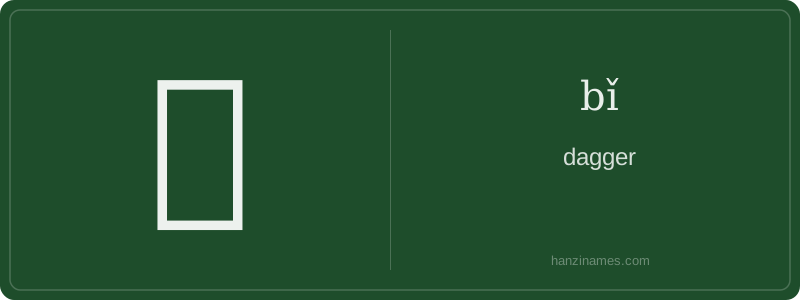
匕 is rarely used independently in modern Mandarin. It appears almost exclusively in compound words (e.g., 匕首 bǐshǒu 'dagger') or historical/military terminology. No common idioms feature 匕 alone; it does not appear in the HSK vocabulary lists at any level. Its primary contemporary use is in formal writing about ancient warfare or archaeology—never in daily speech or informal contexts.
The character is a documented pictograph: oracle bone inscriptions clearly depict a ceremonial spoon with a shallow bowl and elongated handle. Bronze inscriptions from the Western Zhou confirm this usage in ancestral rites. There is no credible oracle-bone evidence for a 'dagger' reading in the earliest period—this meaning emerged later through graphic analogy.
As an archaeologist brushing dust from a Shang dynasty oracle bone, I first encountered 匕 not as a weapon—but as a ritual spoon. Its two-stroke form mirrors excavated bronze spoons used in ancestral ceremonies: a curved bowl and a straight handle. Early inscriptions show it paired with sacrificial vessels, confirming its role in food offerings—not combat. This shifts our understanding: 匕 was a sacred utensil long before it meant 'dagger'.
Linguistic stratigraphy reveals semantic layering: the same character later acquired the meaning 'dagger' due to visual resemblance—its shape echoed the short, curved blade of Zhou-period bronze knives. This is not metaphor but metonymy: the tool’s form became shorthand for the weapon it resembled. Such dual meanings are common in early Chinese script, where function and form blurred in ritual contexts.
Modern dictionaries list 'dagger' first, but epigraphic evidence proves 'spoon' is older—attested in over 200 oracle bone and bronze inscriptions. The dagger sense appears only in Warring States texts like the *Zuo Zhuan*, centuries later. Thus, 匕 is a palimpsest: a single glyph bearing two historically sequential meanings, preserved not by design but by scribal continuity. To read it is to hold time in two strokes.
Example Sentences
Common Compounds
Similar Characters — Don't Mix These Up
Your First Step into Chinese Culture: Get a Chinese Name
Every journey into Chinese begins with a name. Use our free Chinese name generator to create a meaningful, personalized Chinese name that fits you perfectly.
Get My Chinese Name →