匡
Character Story & Explanation
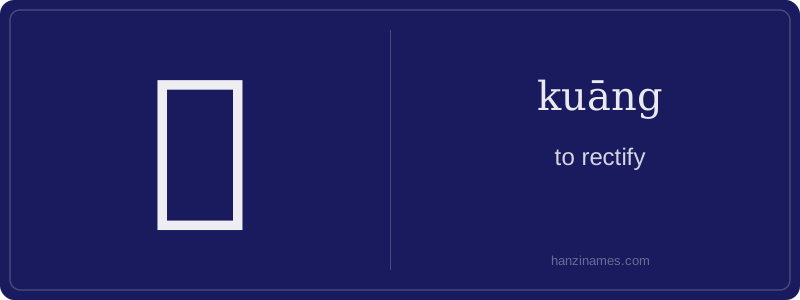
In modern Chinese, 匡 appears most frequently in formal written contexts—especially in compound words like 匡正 (kuāngzhèng, 'to rectify') and 匡救 (kuāngjiù, 'to remedy'). It’s common in official media, academic critiques, and historical narratives: for example, Xinhua News Agency used 匡正 in a 2021 editorial urging accurate historical education. The idiom 匡时济世 (kuāng shí jì shì, 'to rectify the age and aid society') originates from Ming–Qing scholarly discourse and remains in use by intellectuals advocating social reform.
The character 匡 is not pictographic; its earliest attestation is in bronze inscriptions of the Western Zhou (c. 1046–771 BCE), where it likely represented a container or frame—evolving semantically to ‘enclose and set right’. Though its original form may have depicted a basket-like vessel (hence the 匚 radical), no oracle bone form survives. Today, Chinese people encounter it most often in printed editorials, university ethics guidelines, or museum exhibition captions describing restoration efforts.
Imagine a quiet courtyard in Suzhou’s Pingjiang Road, where an elderly calligrapher adjusts a crooked inkstone on his desk. With gentle fingers, he ‘rectifies’ its position—aligning it precisely so the brush glides smoothly. This small act embodies 匡 (kuāng): not forceful correction, but thoughtful realignment to restore balance and function. In Chinese philosophy, rectification isn’t about punishment—it’s harmonious restoration, like tuning a guqin string or straightening a leaning scholar’s scroll rack.
Historically, 匡 appears in classical texts like the *Analects*, where Confucius urges rulers to ‘rectify names’ (正名, zhèngmíng)—ensuring titles match responsibilities. This ethical precision reflects 匡’s core: moral and structural realignment. The character itself, with its enclosing 匚 radical, suggests containment and guidance—like framing truth within proper boundaries, rather than erasing error.
Today, 匡 is rare in casual speech but resonates in formal, literary, or bureaucratic contexts. You’ll find it in phrases like 匡正 (kuāngzhèng, 'to correct and improve') used in education policy documents or editorial prefaces. Its tone is respectful, even humble—never scolding. It implies collaboration: the one who ‘rectifies’ does so alongside others, as a gardener prunes a tree not to dominate it, but to help it grow upright and strong.
Example Sentences
Common Compounds
Similar Characters — Don't Mix These Up
Your First Step into Chinese Culture: Get a Chinese Name
Every journey into Chinese begins with a name. Use our free Chinese name generator to create a meaningful, personalized Chinese name that fits you perfectly.
Get My Chinese Name →