匦
Character Story & Explanation
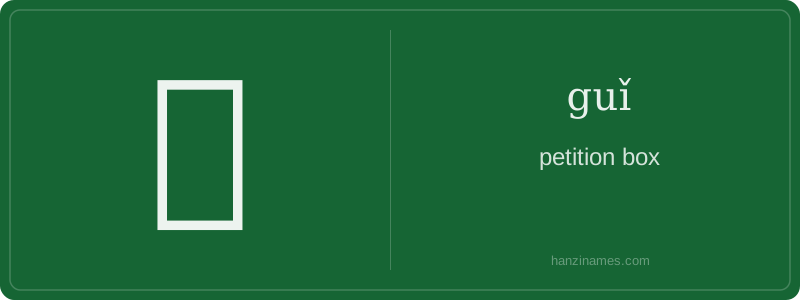
In modern Chinese, 匦 is almost exclusively used in formal or historical contexts—not in daily speech, but in bureaucratic, archival, and ceremonial settings. It appears in phrases like '意见箱' (yìjiàn xiāng, suggestion box), where 匦 is the classical root for 'box' in official terminology; more precisely, it survives in compound words such as '匦函' (guǐ hán, sealed memorial envelope) and '投匦' (tóu guǐ, to submit a petition into an official box)—a practice revived symbolically in some government transparency initiatives. Historically, Tang Dynasty emperors installed '匦' boxes in Chang’an to receive anonymous remonstrances from officials and commoners alike.
The character’s origin is well-documented: it is a stylized pictograph of a rectangular, lid-covered wooden box, first appearing in bronze inscriptions with clear enclosure lines. The radical 匚 represents the frame or side walls, while the inner 厶 suggests closure or interior space—no oracle-bone variant is attested, but Western Zhou bronzes show near-identical forms used exclusively for ritual containers.
Unearthing 匦 (guǐ) feels like brushing dust from a lacquered Zhou dynasty ritual container—its shape, a simple open rectangle with a lid implied by the top stroke, is one of the earliest standardized representations of a covered box in Chinese script. Unlike pictographs that evolved into abstract forms, 匦 retains its structural honesty: the radical 匚 (fāng) denotes an enclosure, and the inner component 厶 (sī) once suggested containment or secrecy—fitting for a vessel meant to hold offerings, documents, or imperial petitions.
This character appears in bronze inscriptions as early as the Western Zhou (1046–771 BCE), not as a generic 'box' but as a ceremonial receptacle—often paired with terms like 'ritual wine' or 'sealed memorial.' Its eight-stroke form stabilized during the Qin small seal script reforms, shedding earlier variants with extra strokes or decorative flourishes. The consistency across millennia speaks to its functional precision: not just any container, but one designed for reverence, confidentiality, or official procedure.
Modern scholars note that 匦 never became a high-frequency character in vernacular use—its survival is largely institutional and literary. Yet its presence in classical texts like the *Rites of Zhou* and Tang legal codes reveals how deeply material culture shaped language: the physical act of placing a petition into a designated box codified accountability. To read 匦 is to hold a linguistic artifact—a sealed vessel still echoing with the weight of ancient protocol.
Example Sentences
Common Compounds
Similar Characters — Don't Mix These Up
Your First Step into Chinese Culture: Get a Chinese Name
Every journey into Chinese begins with a name. Use our free Chinese name generator to create a meaningful, personalized Chinese name that fits you perfectly.
Get My Chinese Name →