匿
Character Story & Explanation
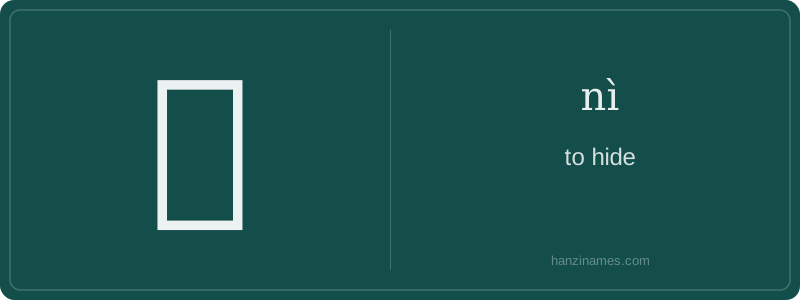
匿 is commonly used in formal, legal, and journalistic contexts in modern Chinese. It appears in official documents, news reports, and idioms like 匿名举报 (nìmíng jǔbào, 'anonymous reporting')—a widely recognized practice enabled by digital platforms in China since the 2010s. The phrase 匿名 (nìmíng, 'anonymous') is especially frequent online, appearing on government complaint portals and social media moderation tools. Historically, 匿 appears in the *Book of Han* (《汉书》, 1st c. CE) describing officials who 'hid crimes' (匿罪) to protect allies—a documented usage reflecting its longstanding association with evasion of duty.
匿 is not a pictograph but a phono-semantic compound: the radical 匸 (xì) suggests enclosure or concealment (as in 'hiding place'), while the phonetic component 若 (ruò) once approximated the pronunciation. Though 若 now sounds different, this structure was standardized in the Qin dynasty’s small seal script. No oracle bone form survives—its earliest verified form is in bronze inscriptions from the Warring States period, consistently meaning 'to hide'.
The Chinese character 匿 (nì) conveys the core idea of concealment—hiding something from view, knowledge, or detection. Unlike English verbs like 'hide' or 'conceal', which often imply physical action, 匿 carries a more deliberate, sometimes secretive or evasive nuance. It appears in formal and literary contexts more than casual speech, suggesting intentionality and awareness—akin to 'going underground' or 'operating incognito' rather than simply ducking behind a door.
In classical Chinese, 匿 frequently appeared in legal and moral texts to describe withholding truth or evading responsibility—e.g., concealing a crime or shielding a wrongdoer. This ethical weight persists: modern usage still implies moral ambiguity, as in 'hiding evidence' or 'remaining anonymous to avoid accountability'. Western equivalents like 'to cloak', 'to suppress', or 'to go dark' capture parts of this sense—but none fuse legality, intention, and discretion as tightly as 匿 does.
Culturally, 匿 resonates with Confucian ideals of transparency and accountability: hiding one’s faults or actions is often framed as morally suspect. Compare this with Western individualistic values where privacy or anonymity (e.g., whistleblower protections, encrypted messaging) can be ethically justified. Thus, 匿 isn’t neutral—it subtly judges the act of hiding. Its rarity in daily conversation reflects this gravity: it’s deployed when concealment matters—legally, politically, or existentially—not for trivial reasons like hiding a birthday present.
Example Sentences
Common Compounds
Similar Characters — Don't Mix These Up
Your First Step into Chinese Culture: Get a Chinese Name
Every journey into Chinese begins with a name. Use our free Chinese name generator to create a meaningful, personalized Chinese name that fits you perfectly.
Get My Chinese Name →