卌
Character Story & Explanation
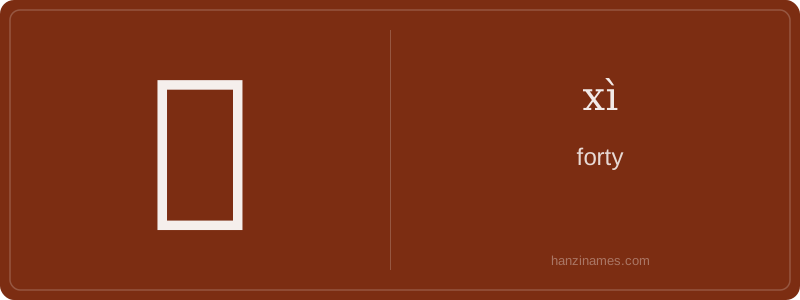
卌 is virtually absent from contemporary spoken or written Mandarin. It appears almost exclusively in pre-modern texts (e.g., Song–Qing dynasty steles, Buddhist sutra colophons), rare idioms like 卌年如一日 (xì nián rú yī rì, 'forty years as one day' — emphasizing unwavering consistency), and occasionally in artistic calligraphy or seal carving. Modern dictionaries list it as 'archaic' or 'literary'; it’s excluded from the HSK syllabus and primary school curricula.
The character is a simplified ligature: four 十 (ten) stacked vertically to mean 'four tens'. This additive formation is documented in Tang dynasty manuscripts and Ming-Qing epigraphy. Though not found in oracle bone or bronze inscriptions, its structure is consistent with Han-era shorthand numeral practices — a practical compression for scribes and engravers needing space-efficient notation.
卌 (xì) is an archaic Chinese character meaning 'forty', composed of four 十 (shí, 'ten') symbols stacked vertically. Unlike the standard modern form 四十 (sìshí), 卌 appears in classical texts, inscriptions, and stylized contexts — not in daily speech or writing. Its compact, symmetrical shape reflects ancient numeral efficiency, where repetition signified multiplication (e.g., 卌 = 4 × 十). It’s rarely taught in schools today but remains visible in calligraphy, historical documents, and temple inscriptions.
This character exemplifies how Chinese numerals evolved from additive notation to standardized compound forms. While 四十 dominates modern usage, 卌 survives as a cultural artifact — akin to Roman 'XL' in English: understood by scholars and aesthetically valued, yet functionally obsolete. Its five-stroke structure (丨丿一丨一) follows a precise vertical stacking order, making it distinct from similarly shaped characters like 卅 (sà, 'thirty') or 卍 (wàn, 'swastika symbol').
In cross-cultural comparison, 卌 parallels Western archaic numerals like 'XL' (Roman forty) or Old English 'feowertig' — both preserved in formal, literary, or decorative settings rather than everyday use. Like 'XL', 卌 conveys brevity and elegance but requires contextual awareness. Unlike alphabetic numerals, however, 卌 is logographic: its meaning is inseparable from its visual form, embedding mathematical logic into calligraphic art — a fusion of number, symbol, and stroke discipline unique to Chinese writing.
Example Sentences
Common Compounds
Similar Characters — Don't Mix These Up
Your First Step into Chinese Culture: Get a Chinese Name
Every journey into Chinese begins with a name. Use our free Chinese name generator to create a meaningful, personalized Chinese name that fits you perfectly.
Get My Chinese Name →