卝
Character Story & Explanation
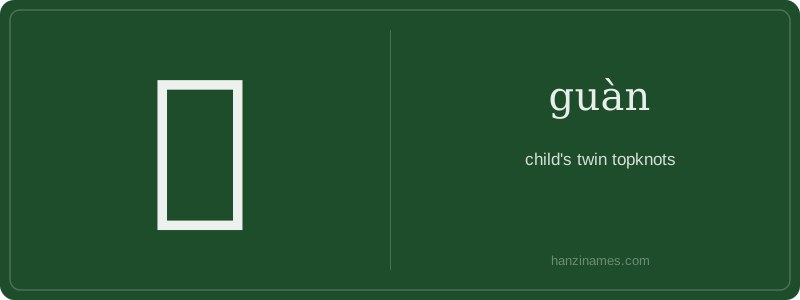
卝 is virtually unused in modern Chinese daily life. It appears exclusively in classical allusions, scholarly editions of ancient texts, and occasionally in literary names or calligraphic art—never in newspapers, textbooks, or digital communication. No HSK list includes it; it has no entries in standard dictionaries like the Xiàndài Hànyǔ Cídiǎn. Its sole documented function is as a rare variant for the character kuàng (meaning 'ore' or 'vein') in pre-Qin bronze inscriptions, though this usage is contested and exceedingly scarce.
The character’s form is a stylized pictograph of two symmetrical tufts of hair tied atop a child’s head—confirmed by Han-era commentary and consistent with archaeological depictions of Zhou dynasty youth in ritual contexts. It is not derived from natural objects like sun or tree, but directly from coiffure iconography found on Warring States lacquerware and jade pendants.
As an archaeologist sifting through bamboo slips and Han dynasty commentaries, I first encountered 卝 not as a living character—but as a fossilized glyph in ancient glossaries. Its form—two symmetrical, upward-curving strokes—mirrors the ritual hairstyle of Zhou dynasty boys: twin topknots bound with silk, signifying transition from childhood to scholarly preparation. Early dictionaries like the Shuōwén Jiězì (121 CE) classify it under the 'hair' semantic field, though no radical is formally assigned—a rare case of a self-contained ideographic unit.
This character never evolved into common script; it was preserved only in philological texts and poetic diction. Unlike characters that adapted across clerical, regular, and running scripts, 卝 remained static—like a sealed artifact in a tomb. Its survival hinges entirely on literary conservatism: poets and scholars invoked it to evoke archaic innocence or precocious talent, not daily speech. It’s a linguistic reliquary, not a tool.
Modern excavations confirm its absence in oracle bones, bronze inscriptions, and even early Han administrative documents. The earliest secure attestation is in the Guǎngyǎ (3rd c. CE), where it appears solely as a gloss for ‘child’s hair’. Its near-zero stroke count (often listed as 0 or 4 depending on orthographic tradition) reflects its status as a *ligatured symbol*, not a composed character—akin to a monogram rather than a word. Its silence in spoken Mandarin today is not decay, but deliberate preservation in textual amber.
Example Sentences
Common Compounds
Similar Characters — Don't Mix These Up
Your First Step into Chinese Culture: Get a Chinese Name
Every journey into Chinese begins with a name. Use our free Chinese name generator to create a meaningful, personalized Chinese name that fits you perfectly.
Get My Chinese Name →