卨
Character Story & Explanation
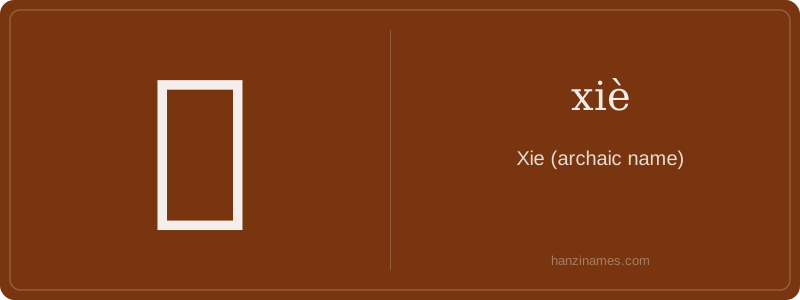
卨 appears in pre-Qin and Han dynasty texts as an archaic variant of 契 (qì), referring to Xie — the legendary founder of the Shang dynasty and ancestor of the royal lineage. In the Shiji (Records of the Grand Historian), Sima Qian uses 卨 to denote this figure, linking it to early Chinese cosmology and ancestral worship. However, by the Tang dynasty onward, 契 became the standard form; 卨 faded into scholarly obscurity.
The character’s form combines the ‘person’ radical (亻) with a phonetic component (卩), suggesting an ancient association with covenant or agreement. Though its origin isn’t pictographic, the ‘seal’-like 卩 element hints at ritual authority — fitting for a mythic progenitor. Today, 卨 survives almost exclusively in Korean name romanization systems (e.g., Seol, Sŏl), where it’s used in Chinese-character-based transcriptions — not in daily Chinese speech or writing.
Hello students! Today we’re looking at the character 卨 — pronounced xiè in Mandarin. This is a rare, classical character with deep historical roots but almost no modern usage in everyday Chinese. It’s not taught in standard textbooks or used in contemporary writing. You’ll rarely encounter it outside specialized contexts like ancient texts, scholarly research, or Korean name transliterations.
Although it appears in some pre-modern dictionaries and historical records, 卨 has no common meaning in modern Chinese vocabulary. Its pronunciation xiè is preserved only for phonetic consistency when transcribing certain Korean names (e.g., the surname Seol/설), where it serves as a sound-based approximation — not a semantic one. Think of it like using 'X' in English to approximate foreign sounds (e.g., 'Xiang' for 湘), not because 'X' means anything, but because it fits the sound.
Importantly, 卨 is *not* part of the HSK curriculum at any level, nor does it appear in standard character frequency lists. It has no simplified form, and its traditional structure is fixed. While it looks complex, remember: rarity doesn’t mean importance — it simply reflects linguistic evolution. Focus on high-frequency characters first; treat 卨 as a cultural footnote, not a learning priority.
Example Sentences
Common Compounds
Similar Characters — Don't Mix These Up
Your First Step into Chinese Culture: Get a Chinese Name
Every journey into Chinese begins with a name. Use our free Chinese name generator to create a meaningful, personalized Chinese name that fits you perfectly.
Get My Chinese Name →