累
Character Story & Explanation
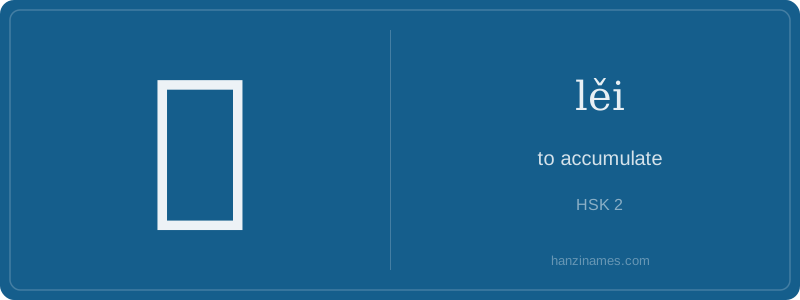
In daily Chinese, 累 (lěi) most commonly appears in formal or technical contexts meaning 'to accumulate' or 'cumulative': e.g., 累计 (lěijì, 'cumulative'), 累犯 (lěifàn, 'repeat offender'), and 累积 (lěijī, 'to accumulate'). It features in official statistics, legal texts, and financial reports—never in casual speech for 'tired' (that’s lèi, written identically but etymologically distinct). A well-documented idiom is 日积月累 (rì jī yuè lěi, 'day by day, month by month accumulate'), appearing in Zhu Xi’s Neo-Confucian writings (12th c.) to describe gradual moral cultivation.
The character’s earliest attested form appears in seal script (c. 3rd c. BCE), combining 糸 (thread/silk) with 畾 (repeated fields), reflecting its original sense of systematic, layered counting—likely tied to granary inventories or corvée labor records. No oracle bone form survives, but its Warring States bronze inscriptions confirm its administrative function.
As an archaeologist brushing dust from a Han dynasty bamboo slip, I find 累 inscribed in clerical script—not as a weary sigh, but as a precise ledger entry: grain stores accumulating season after season. Its radical 糸 (silk thread) hints at ancient accounting—threads knotted to tally tribute, harvests, or labor days. This was not abstract accumulation; it was tangible, bureaucratic, vital to imperial stability.
Later, in Tang steles and Song printing blocks, 累 evolves semantically: from physical stockpiling to abstract buildup—knowledge, debt, evidence. The character’s three-tiered structure (畾 + 糸) echoes repetition: three stacked ‘fields’ (畾, an archaic variant of 畾 meaning ‘many’) bound by thread, visually encoding the idea of layer upon layer.
The phonetic component 畾 (lěi) anchors pronunciation while reinforcing meaning—its repetition mirrors accumulation itself. Even today, when a modern accountant types 累计 (lěijì, 'cumulative total') into financial software, they’re continuing a 2,200-year-old practice: using this character to mark what grows, compounds, and persists across time.
Example Sentences
Common Compounds
Similar Characters — Don't Mix These Up
Your First Step into Chinese Culture: Get a Chinese Name
Every journey into Chinese begins with a name. Use our free Chinese name generator to create a meaningful, personalized Chinese name that fits you perfectly.
Get My Chinese Name →