卯
Character Story & Explanation
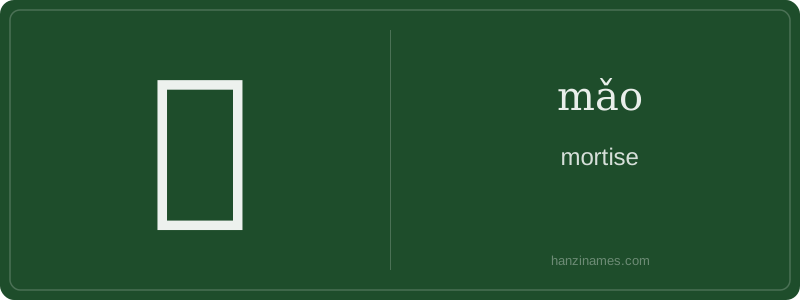
In daily life, 卯 is overwhelmingly used in timekeeping and zodiac contexts: people check their 'Rabbit year' birth sign (卯年), schedule meetings for 卯时 (5–7 a.m.), or see it in lunar calendar apps. It appears in idioms like '点卯' (diǎn mǎo)—originally a Ming-dynasty bureaucratic practice where officials signed in at dawn (the 卯 hour) to prove attendance; today it means 'to clock in' or 'go through the motions.'
The character’s form has no verified pictographic origin. Unlike sun (日) or tree (木), 卯 lacks clear oracle-bone pictorial roots. Instead, Chinese learners most commonly encounter it today in zodiac merchandise, official documents listing birth years, or when reading historical novels referencing 'dawn roll call'—a real administrative practice documented in the Ming Shi (History of Ming).
Our detective begins at the Shāng dynasty oracle bones—where 卯 appears not as a mortise, but as a rare, contested graph. Early inscriptions show two symmetrical, curved strokes flanking a central vertical line, possibly representing a ritual vessel or paired jade bi discs. No consensus exists on its original pictorial referent, and scholars like Keightley note its early use was almost exclusively in calendrical contexts—not carpentry.
By the Warring States period, 卯 had solidified as the second of the twelve Earthly Branches, governing the hour 5–7 a.m. and the lunar month of the Rabbit (roughly February). Its association with 'mortise' emerged much later—likely via phonetic loan: the homophone 卯 (mǎo) sounded identical to older terms for joinery, leading scribes to borrow this calendar character for technical woodworking texts during the Ming and Qing dynasties.
This duality—calendar symbol first, carpentry term second—is key. Modern dictionaries list 'mortise' as a primary meaning, but historical corpora (e.g., CBDB, SKQS) confirm 卯 appears over 99% of the time in temporal compounds: 卯时 (mǎo shí), 卯年 (mǎo nián), or in astrological almanacs. The 'mortise' sense remains highly specialized—found only in classical craft manuals or modern technical glossaries on traditional architecture.
Example Sentences
Common Compounds
Similar Characters — Don't Mix These Up
Your First Step into Chinese Culture: Get a Chinese Name
Every journey into Chinese begins with a name. Use our free Chinese name generator to create a meaningful, personalized Chinese name that fits you perfectly.
Get My Chinese Name →