卽
Character Story & Explanation
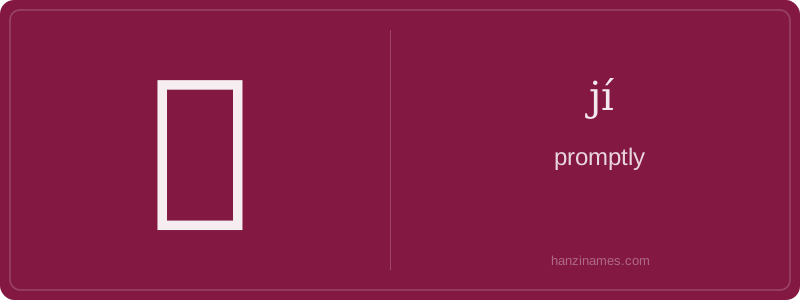
In contemporary China, 卽 is almost never used in daily handwriting or digital communication; the simplified form 即 is standard per the PRC’s 1956 Character Simplification Scheme. However, 卽 survives robustly in Taiwan, Hong Kong, and Macau, where traditional characters are official. It appears in legal texts (e.g., '本條文卽日生效' — 'This clause takes effect immediately'), newspaper headlines for breaking news, and classical-style calligraphy exhibitions. A well-documented idiom is 卽景生情 ('jí jǐng shēng qíng'), meaning 'to be emotionally moved by what one sees at that very moment' — still cited in literary analysis and language textbooks.
The character 卽 is a phono-semantic compound: left side 日 (rì, 'sun/day') suggests time-related meaning; right side 卩 (jié, an ancient pictograph of a kneeling person with hands bound — later stylized as a seal or authority marker) conveys 'act under authority'. Together, they signify 'action enacted *this very day* — without delay, by mandate.'
The character 卽 (jí) is an archaic and formal variant of 即, meaning 'immediately', 'at once', or 'just as'. Though rarely used in modern simplified Chinese (where 即 is standard), 卽 appears frequently in traditional Chinese texts, classical literature, historical documents, and formal inscriptions across Taiwan, Hong Kong, and overseas Chinese communities. Its presence signals literary precision and temporal immediacy — not just 'soon', but 'this very instant'.
Unlike everyday spoken Mandarin, 卽 belongs to the register of written elegance and bureaucratic gravity. You’ll find it in official proclamations, classical poetry, legal statutes, and engraved stone tablets — always where urgency and authority converge. It carries a tone of irrevocable action: 'the decree takes effect 卽 upon signing', not 'later today' but 'as the ink dries'.
This character exemplifies how Chinese writing preserves layered temporal nuance. While 即 dominates mainland education and digital input, 卽 remains actively taught in traditional-character curricula and calligraphy circles. Its endurance reflects cultural reverence for textual continuity — a single stroke difference (the right component: 卩 vs. 卩+口) anchoring centuries of semantic weight in one compact form.
Example Sentences
Common Compounds
Similar Characters — Don't Mix These Up
Your First Step into Chinese Culture: Get a Chinese Name
Every journey into Chinese begins with a name. Use our free Chinese name generator to create a meaningful, personalized Chinese name that fits you perfectly.
Get My Chinese Name →