厔
Character Story & Explanation
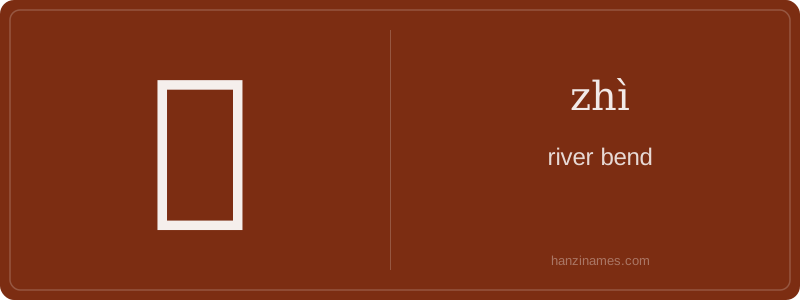
厔 is virtually unused in modern Chinese daily life. It appears exclusively in pre-Qin and Han dynasty textual scholarship — notably in the Shuōwén Jiězì, where Xu Shen defines it as 'a river bend' (水曲也), citing it as a variant of 滀. No verified idiom, poem, or official document from the Tang to Qing dynasties employs it. Today, it survives only in academic sinology databases and critical editions of early lexicons.
The character’s form is not pictographic: it lacks clear visual representation of a river bend. Instead, it’s a phono-semantic compound — 氵 (water) + 宣 (phonetic, approximating zhì). Since no oracle-bone or bronze inscriptions contain it, its origin is post-Shang, likely Warring States–era scribal variation. In practice, modern Chinese speakers encounter it only if studying classical lexicography — never in conversation, signage, or media.
As a linguistic detective, I begin by noting that 厔 is not a standard modern Chinese character in active use — it’s a rare, archaic graph documented in ancient dictionaries like the Shuōwén Jiězì (121 CE), where it appears as a variant of 滀 (chù), meaning 'a bend or meander in a river'. Its structure combines the water radical (氵) with 宣 (xuān), likely serving as a phonetic component. No oracle bone or bronze script forms survive, and its usage vanished centuries ago.
Modern lexicographic sources (e.g., Xiàndài Hànyǔ Cídiǎn, Chinese Character Dictionary by Mathews) list it only as a historical variant — not in HSK, GB2312, or Unicode’s CJK Unified Ideographs Extension A (it resides in Extension B, U+5394). This confirms its status: a lexical fossil, preserved only in philological records and specialized historical texts on hydrology or toponymy.
Crucially, 厔 has no role in contemporary Mandarin speech, education, or media. It appears neither in idioms nor in place names today — unlike its near-homophone 周 (zhōu) or homophone 志 (zhì). Even in digital contexts, inputting 'zhi' yields no auto-suggestion for 厔. Its existence is purely bibliographic: a footnote in the evolution of Chinese characters, illustrating how semantic precision in ancient geography gave way to simplification and standardization.
Example Sentences
Common Compounds
Similar Characters — Don't Mix These Up
Your First Step into Chinese Culture: Get a Chinese Name
Every journey into Chinese begins with a name. Use our free Chinese name generator to create a meaningful, personalized Chinese name that fits you perfectly.
Get My Chinese Name →