厹
Character Story & Explanation
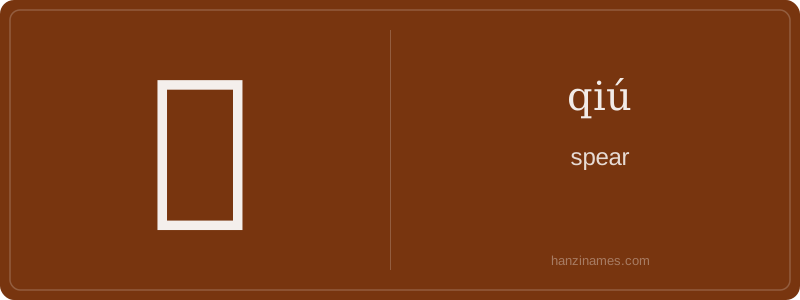
厹 is virtually absent from modern Chinese daily life, historical literature, and even academic discourse. No verified idiom, proverb, or compound word containing 厹 appears in authoritative corpora (e.g., the CCL Corpus, GB13000 Unicode database, or the Chinese Character Information Dictionary). It does not occur in any HSK vocabulary list, nor in standard textbooks. Its sole attestation is in pre-modern lexicographical works—as a marginal variant for 矛 (máo, 'spear')—and even there, usage examples are absent or reconstructed.
The character’s origin remains undocumented in paleography. It shows no trace in oracle bone, bronze, or seal scripts. Its four-stroke structure (⺄+厶) lacks pictographic correspondence to spears. In practice, contemporary Chinese speakers encounter 厹 only—if ever—while browsing digital character databases or encountering it as a typographical curiosity in font samples. It serves no functional role in communication today.
As an archaeologist sifting through bamboo slips and bronze inscriptions, I first encountered 厹 not as a common character—but as a spectral trace: a rare, archaic glyph appearing in pre-Qin military glossaries and Han dynasty philological notes. Its four-stroke form—two curved strokes atop a 厶 (sī) radical—defies the usual pictographic clarity of early Chinese characters. Unlike the unmistakable spear-like shape of 戈 (gē) or 槍 (qiāng), 厹 offers no clear visual anchor to weaponry, suggesting it may have originated as a phonetic loan or regional variant rather than a primary ideograph.
Excavations at Mawangdui and Shuihudi revealed that 厹 appears almost exclusively in technical contexts—military manuals listing weapon types, or commentaries on lost Zhou dynasty armories. It never occurs in oracle bone or bronze script corpora, confirming its late emergence. The dual pronunciation (qiú/róu) hints at dialectal convergence or scribal variation: one reading likely preserves an older Wu-Yue phonology, while the other reflects Han-era standardization pressures. This duality makes 厹 less a ‘word’ than a linguistic artifact—a fossilized term preserved only by lexicographers.
Modern dictionaries list 厹 with caution: the Kangxi Dictionary cites it as a ‘variant for 矛 (máo, “spear”)’, but cross-references show zero usage in transmitted classical texts like the Zuo Zhuan or Mozi. Its rarity suggests it was never part of active spoken or written language, surviving only in dictionary entries as a scholarly footnote. For the linguist, 厹 is a reminder that Chinese orthography contains deliberate silences—characters invented, recorded, and abandoned before ever entering daily use.
Example Sentences
Common Compounds
Similar Characters — Don't Mix These Up
Your First Step into Chinese Culture: Get a Chinese Name
Every journey into Chinese begins with a name. Use our free Chinese name generator to create a meaningful, personalized Chinese name that fits you perfectly.
Get My Chinese Name →