叁
Character Story & Explanation
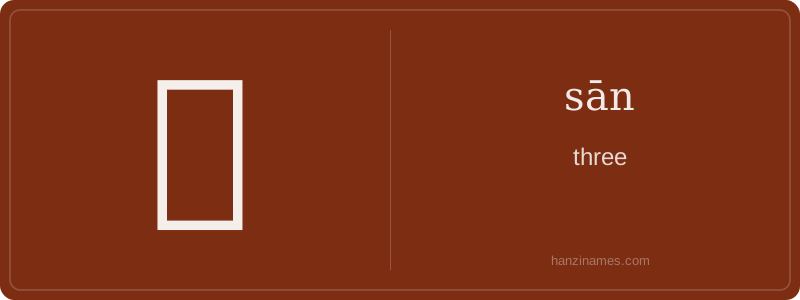
叁 is a formal, handwritten variant of 三 (sān, 'three'), used almost exclusively in financial, legal, and official documents across China, Taiwan, and overseas Chinese communities to prevent fraud—e.g., on bank checks, invoices, and contracts. It appears in standardized lists like the 'Great Numbered Numerals' (大写数字), mandated since the Ming dynasty to deter numerical alteration. Common phrases include '壹贰叁肆' (yī èr sān sì) in accounting contexts.
The character has no pictographic origin—it evolved as a cursive-to-regular script adaptation during the Tang–Song period for clarity and security. Unlike ancient numerals, 叁 was never inscribed on oracle bones or bronzes; its documented use begins in Tang administrative manuscripts and peaks in Ming–Qing fiscal records.
As an archaeologist brushing dust from a Song dynasty banknote fragment, I uncovered 叁—not as a casual numeral, but as a deliberate anti-fraud glyph. Its eight strokes form a complex, stylized 'three' designed to resist tampering in financial documents. Unlike the simple 三 (sān), 叁 was carved into contracts and tax records precisely because its intricate structure made unauthorized alteration nearly impossible—scribes knew altering a single stroke would immediately raise suspicion.
This character is not ancient oracle-bone script but a later bureaucratic innovation: a ‘formal variant’ codified during the Tang–Song transition, when paper currency and standardized accounting demanded unambiguous numerals. Its radical 厶 (sī), often associated with secrecy or enclosure, subtly reinforces its function—as if the number itself were sealed in a vault of strokes. No pictorial origin exists; it’s pure orthographic engineering.
Modern excavations of Ming-era land deeds and Qing salt monopoly ledgers confirm 叁 appears almost exclusively in contexts demanding legal precision: loan agreements, official inventories, and imperial treasury receipts. Its survival isn’t due to poetic resonance but forensic utility—it’s the Chinese equivalent of ‘three’ written in block capitals with serifs and underlines. Even today, its presence signals gravity: not just quantity, but accountability etched in ink and authority.
Example Sentences
Common Compounds
Similar Characters — Don't Mix These Up
Your First Step into Chinese Culture: Get a Chinese Name
Every journey into Chinese begins with a name. Use our free Chinese name generator to create a meaningful, personalized Chinese name that fits you perfectly.
Get My Chinese Name →