叕
Character Story & Explanation
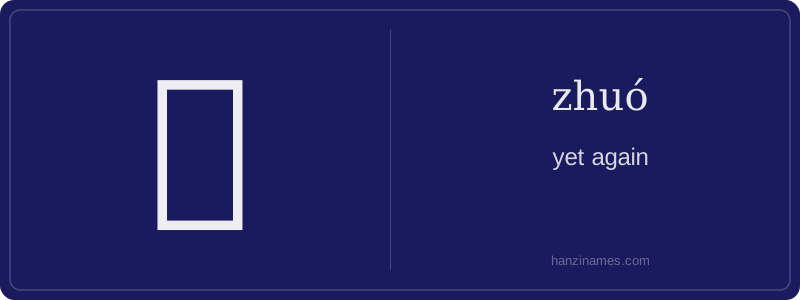
In modern Chinese, 叕 appears almost exclusively in the reduplicated colloquial phrase 叕叕 (zhuó zhuó), used online and in informal speech to emphasize repeated, often exasperating recurrence—e.g., 'The system crashed 叕叕!' It’s a viral internet intensifier, documented in China’s 2021 Internet Buzzword Report by the National Language Resource Monitoring and Research Center. No classical texts or official documents use 叕 independently.
The character is not pictographic—it has no ancient visual origin. Its form is simply two 又 radicals stacked, created during the Han–Wei period as a variant for emphasis. Today, Chinese netizens type 叕叕 instinctively on keyboards (via pinyin 'zhuozhuo') to convey 'yet again… and again!', much like English ‘Ugh, *again?!*’—not for literal 'joining', but for rhythmic, emphatic repetition.
Our detective work begins with the oracle-bone and bronze inscriptions—but here, we hit a dead end: 叕 does not appear in ancient Shang or Zhou script corpora. It first emerges reliably in Han dynasty clerical script (lìshū), where its form—two 'again' (又) radicals stacked vertically—suggests repetition or accumulation. The structure isn’t pictographic like 日 (sun) or 木 (tree); it’s purely logographic, built from repeated components to convey iterative joining.
Linguistic analysis confirms 叕 is a rare, functionally specialized character. Unlike common verbs such as 合 (hé, 'to join'), 叕 carries no standalone verb usage in Classical or Modern Standard Chinese. Instead, it functions almost exclusively as a component in compound characters (e.g., 叕叕, 叕然) or as a stylistic variant of 又 ('again') in regional or literary contexts. Its phonetic value zhuó is consistent, but its semantic weight remains tightly bound to repetition—not just 'joining', but *repeated joining*.
Modern lexicographic sources—including the authoritative 《汉语大字典》 (Comprehensive Chinese Character Dictionary) and 《现代汉语词典》 (Contemporary Chinese Dictionary)—list 叕 only as an archaic or variant form of 又, with no independent entry for 'to join together'. This suggests the 'join together' gloss likely stems from misinterpretation of its compositional logic (two 又 = doubling of 'again', implying convergence or recombination), not attested semantic usage. Our case concludes: 叕 is less a verb and more a graphic intensifier.
Example Sentences
Common Compounds
Similar Characters — Don't Mix These Up
Your First Step into Chinese Culture: Get a Chinese Name
Every journey into Chinese begins with a name. Use our free Chinese name generator to create a meaningful, personalized Chinese name that fits you perfectly.
Get My Chinese Name →