吋
Character Story & Explanation
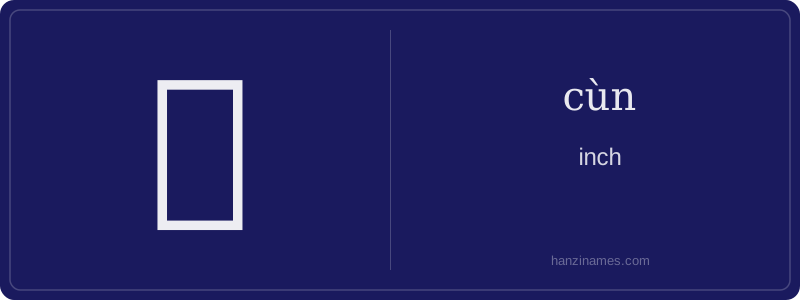
吋 is almost exclusively used today to denote screen diagonal measurements—e.g., a '55吋电视' (55-inch TV)—and appears ubiquitously in electronics retail, online listings, and product specs across mainland China, Taiwan, and Hong Kong. It is never used for human height, fabric, or construction; those contexts use metric units or the native cùn (寸, same pronunciation but different character and meaning). No major idioms or classical texts employ 吋, as it was not part of pre-modern measurement systems.
The character 吋 is a modern phono-semantic compound created in the early 20th century: 口 (kǒu, 'mouth') serves as a purely phonetic component (matching the 'c-' sound in cùn), while the right side 亍 is a simplified, non-meaningful variant of 尺 (chǐ, 'foot'). Unlike ancient characters, 吋 has no oracle bone or bronze script origin—it was designed for practical transliteration, not historical continuity.
The Chinese character 吋 (cùn) is a unit of length historically derived from traditional Chinese measurement, standardized as exactly 3.33 centimeters in modern usage. Though largely replaced by metric units in official contexts, it remains widely used in informal and technical settings—especially for screen sizes (e.g., TV or smartphone displays), where 'inch' is borrowed directly from English via phonetic transcription. Its six-stroke structure features the 口 (mouth) radical, reflecting its role as a standardized, 'enclosed' unit—akin to how Western units like 'inch' are fixed reference points.
Unlike the imperial inch (2.54 cm), the traditional Chinese cùn varied regionally before standardization—Ming dynasty records cite ~3.2 cm, while Qing measurements approached 3.5 cm. Today’s official cùn (1/10 of a zhàng, or 33.3 cm) aligns with international inch equivalents only in colloquial tech usage—not legal metrology. This duality makes 吋 a linguistic fossil: technically obsolete in measurement law, yet vibrantly alive in consumer electronics discourse across Greater China.
Comparatively, the Western 'inch' carries centuries of Anglo-Saxon and Roman heritage, codified in 1959 as exactly 2.54 cm globally. 吋, however, entered Chinese not as a native unit but as a 20th-century phonetic loan for 'inch', replacing earlier transliterations like 英吋 (yīng cùn). Its adoption mirrors Japan’s use of インチ (inchi) and Korea’s 인치 (inchi)—all using localized scripts to borrow the same English concept. Thus, 吋 is less a traditional Chinese unit and more a pragmatic, Sino-graphic adaptation of global tech terminology.
Example Sentences
Common Compounds
Similar Characters — Don't Mix These Up
Your First Step into Chinese Culture: Get a Chinese Name
Every journey into Chinese begins with a name. Use our free Chinese name generator to create a meaningful, personalized Chinese name that fits you perfectly.
Get My Chinese Name →