羊
Character Story & Explanation
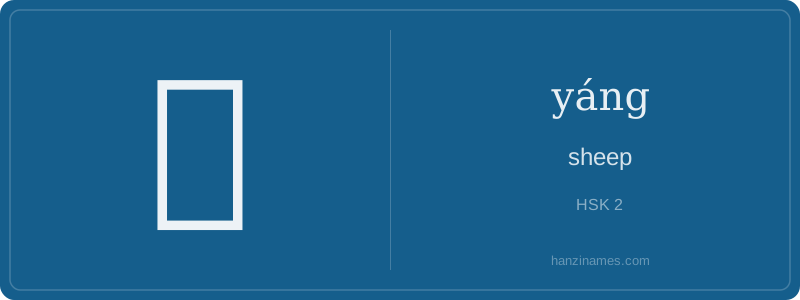
In daily life, 羊 appears frequently in food labels (e.g., 羊肉串 yángròu chuàn, 'lamb skewers'), weather forecasts ('cold wave with snow and wind—watch for sheep-herding disruptions in Ningxia'), and public signage (e.g., 羊场 yángchǎng, 'sheep farm'). It’s central to idioms like 顺手牵羊 shùnshǒu qiān yáng ('to steal opportunistically') and appears in classical texts like the Analects, where Confucius uses sheep sacrifices to discuss ritual propriety (li).
This character originated as a highly recognizable oracle bone pictograph (c. 1200 BCE)—depicting a front-facing sheep head with prominent horns, two eyes, and a simplified body. Archaeological evidence from Yinxu confirms its use in divination inscriptions referring to livestock offerings. Its form has remained remarkably stable across bronze, seal, and clerical scripts—unlike many characters that underwent radical simplification.
The character 羊 (yáng) is a foundational HSK Level 2 character representing both 'sheep' and 'goat'—animals deeply woven into China’s agrarian history and symbolic culture. With just six strokes, it’s one of the earliest Chinese characters to appear in oracle bone inscriptions as a clear pictograph: a stylized head with curved horns, wide eyes, and a short body. Its radical status means it appears in many related characters, such as 美 (měi, 'beautiful')—originally depicting 'a person wearing sheep horns', reflecting ancient associations of sheep with beauty and auspiciousness.
Sheep were vital in ancient northern China for wool, meat, milk, and ritual sacrifice—especially during Zhou Dynasty ceremonies. The character 羊 appears in over 40 standard Chinese characters, often carrying connotations of gentleness, purity, or auspiciousness. In modern Mandarin, it’s used literally (e.g., 羊肉 yángròu, 'mutton') and figuratively (e.g., in idioms like 亡羊补牢 wáng yáng bǔ láo, 'mend the fold after the sheep are lost'—meaning 'to take corrective action after a mistake').
Despite urbanization, sheep farming remains economically significant in Inner Mongolia, Xinjiang, and Gansu—regions where pastoral life sustains traditions like the Nadam Fair, featuring sheep-related competitions and cuisine. The character 羊 also appears in zodiac contexts (the Year of the Sheep/Goat), influencing art, gift-giving, and even baby names—though 'sheep' in the zodiac (yáng) technically encompasses goats and rams due to historical linguistic overlap in Chinese.
Example Sentences
Common Compounds
Similar Characters — Don't Mix These Up
Your First Step into Chinese Culture: Get a Chinese Name
Every journey into Chinese begins with a name. Use our free Chinese name generator to create a meaningful, personalized Chinese name that fits you perfectly.
Get My Chinese Name →