吒
Character Story & Explanation
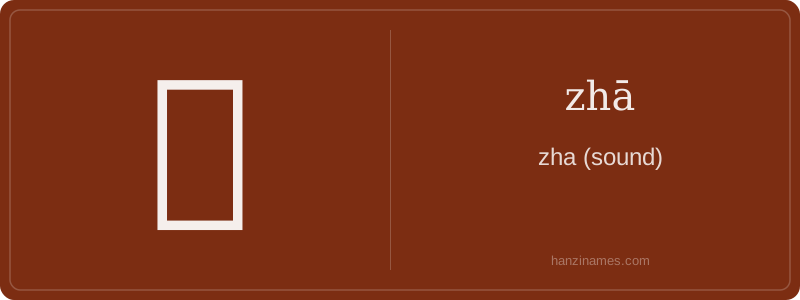
吒 appears almost exclusively in the name 哪吒 (Nézhā), the rebellious child deity from Ming dynasty novels like Fengshen Yanyi (Investiture of the Gods). It is never used independently in modern Mandarin; no dictionaries list it as a standalone word. No idioms, proverbs, or common phrases contain 吒 outside this proper noun. Its presence in education is limited to cultural literacy—not vocabulary acquisition.
The character is not pictographic or ideographic. Its structure (radical 口 + component 乇) evolved from ancient phonetic scripts, but its origin is purely phonetic—not visual. Today, Chinese children encounter 吒 first in animated adaptations of Nezha’s story, on posters at Shanghai Disneyland’s ‘Nezha’ themed zone, or in school lessons about traditional folklore.
The character 吒 (zhā) is a phonetic placeholder—its sole function is to represent the sound 'zha' in mythological names. It carries no independent meaning and appears almost exclusively in proper nouns, especially from Chinese folklore and religious texts. Unlike most Chinese characters, it doesn’t denote an object, action, or concept—it’s purely a linguistic tool for transcription, like using 'X' for an unknown variable in math.
Historically, 吒 entered Chinese writing via transliteration of Sanskrit names during Buddhist scripture translation. The most famous bearer is Nezha (哪吒), whose name combines 哪 (nǎ) and 吒 (zhā)—a phonetic rendering of the Sanskrit 'Nalakuvara'. This reflects China’s long tradition of adapting foreign names into native syllables using existing characters with matching sounds.
Modern usage remains tightly bound to mythology and pop culture: Nezha appears in animated films, temple murals, and even brand names (e.g., Nezha Auto). While rare in daily speech, 吒 is instantly recognizable to Chinese people as part of this iconic name—and its six-stroke form (口 + 刀-like right component) is often practiced by calligraphy beginners learning radical-based structure.
Example Sentences
Common Compounds
Similar Characters — Don't Mix These Up
Your First Step into Chinese Culture: Get a Chinese Name
Every journey into Chinese begins with a name. Use our free Chinese name generator to create a meaningful, personalized Chinese name that fits you perfectly.
Get My Chinese Name →