吮
Character Story & Explanation
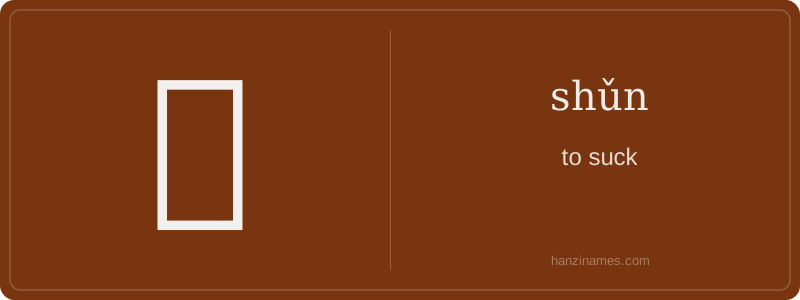
In modern Chinese, 吮 is used primarily in descriptive, often literary or medical contexts—rarely in casual speech. It appears in clinical terms like 吮吸反射 (shǔnxī fǎnshè, 'sucking reflex') and in literature to evoke vulnerability or instinct (e.g., a child 吮手指). It’s absent from HSK lists (not in HSK 1–6), reflecting its specialized register. No classical idiom features it prominently; it’s too concrete, too physical for proverbial abstraction.
The character is not pictographic—it doesn’t depict a mouth sucking. Rather, it’s a phono-semantic compound: 口 (kǒu, 'mouth') signals semantic domain, while 旬 (xún, originally meaning 'ten-day period') provides approximate sound. This structure emerged during the Warring States to Han transition, when standardized character formation prioritized readability over visual mimesis.
As an archaeologist of script, I brush dust from the oracle-bone and bronze inscriptions—yet 吮 (shǔn) does not appear there. It emerges later, in seal script and clerical forms, its structure revealing a deliberate, functional design: the 口 (mouth) radical anchors it firmly in the realm of oral action, while the phonetic component 旬 (xún) hints at pronunciation rather than meaning—a classic example of phono-semantic compounding perfected by the Han dynasty scribes.
This character was never carved for ritual divination or royal proclamations; instead, it surfaced in medical texts and vernacular records describing physiological acts—sucking milk, drawing poison from wounds, or even metaphorical 'sucking up' to power. Its late attestation signals linguistic pragmatism: a word so bodily, so immediate, needed no early glyph—until writing matured enough to document daily human experience with precision.
Examining its seven strokes under magnification, I see economy and intent: the mouth radical is compact and upright, the upper-right stroke of 旬 curves like a tongue retracting—a subtle kinetic echo of the act itself. Unlike pictographs frozen in time, 吮 is a *gestural logograph*: not what is sucked, but *how* the mouth moves. Its stability across 2,000 years of script evolution confirms its semantic indispensability—no synonym displaced it, because no other character captures this precise, moist, inward-directed oral motion.
Example Sentences
Common Compounds
Similar Characters — Don't Mix These Up
Your First Step into Chinese Culture: Get a Chinese Name
Every journey into Chinese begins with a name. Use our free Chinese name generator to create a meaningful, personalized Chinese name that fits you perfectly.
Get My Chinese Name →