呃
Character Story & Explanation
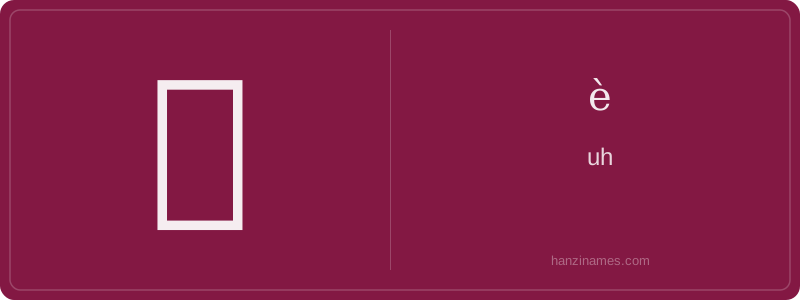
呃 is widely used in modern Mandarin as an interjection representing hesitation, surprise, or — most literally — the sound of a hiccup. It appears frequently in informal writing: subtitles, comics (manhua), social media, and dialogue in novels. While no classical idiom centers on 呃, it’s standard in phrases like 呃…让我想想 (‘Uh… let me think’) or 呃,不太对 (‘Uh, that’s not quite right’). Medical texts sometimes use it descriptively, e.g., 呃逆 (è nì) — the formal term for ‘hiccups’, documented in traditional Chinese medicine classics like the Compendium of Materia Medica (Bencao Gangmu, 1596).
The character 呃 is a late-developing phonosemantic compound: 口 (mouth) + 阿 (ā, here acting phonetically for è). It does not appear in oracle bone or bronze inscriptions. Its form reflects its function — mouth-related sound — and was standardized during the Ming–Qing period as colloquial speech gained written representation.
Hi students! Today we’re learning 呃 (è), a small but expressive character with just 7 strokes and the 口 (mouth) radical. It’s not a common vocabulary word in formal writing, but it’s very alive in spoken Chinese — it’s an interjection, like an audible pause or a hiccup sound. Think of it as the Chinese equivalent of 'uh', 'er', or the physical sound of a hiccup — not a full verb like 'to hiccup' in English grammar, but the *sound itself*.
This character is rarely used alone as a dictionary entry meaning 'to hiccup'; rather, it captures the *vocalized experience* of hiccups or hesitation. Its pronunciation è is a falling tone (4th tone), and it’s often repeated — like 呃呃 — to mimic the staccato, involuntary nature of hiccups. Because it’s onomatopoeic, its meaning comes entirely from sound and context, not logic or composition.
As beginners, don’t worry about memorizing it for essays or exams — it’s not in the HSK lists (HSK Level: Not included). But you’ll hear it constantly in real conversations, cartoons, dramas, and even medical contexts. Recognizing 呃 helps you understand natural speech rhythm, hesitation markers, and bodily sound expressions — key to sounding fluent and human, not textbook-perfect!
Example Sentences
Common Compounds
Similar Characters — Don't Mix These Up
Your First Step into Chinese Culture: Get a Chinese Name
Every journey into Chinese begins with a name. Use our free Chinese name generator to create a meaningful, personalized Chinese name that fits you perfectly.
Get My Chinese Name →