呦
Character Story & Explanation
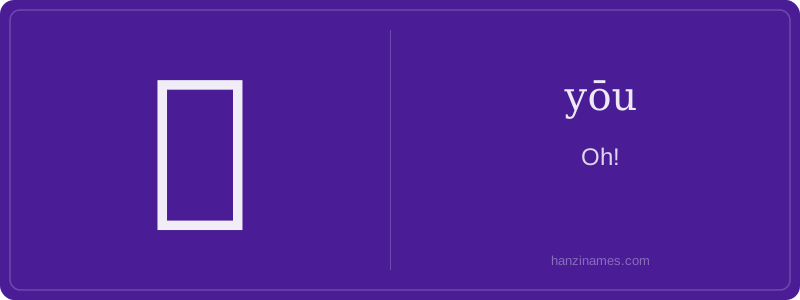
呦 is overwhelmingly used in modern spoken Mandarin as a light, friendly interjection—similar to 'Oh!', 'Hey!', or 'Well now!'—often conveying pleasant surprise, affectionate teasing, or gentle redirection. It appears in dialogue-heavy media (e.g., CCTV’s variety shows, WeChat voice notes, Douyin skits) and is documented in the Xiandai Hanyu Cidian (7th ed., 2016) as an exclamatory particle with a rising-falling tone (yōu). No classical idioms feature it prominently; it’s a colloquial evolution, not a literary holdover.
The character is a phono-semantic compound: 口 (mouth radical) + 幽 (yōu, meaning 'secluded' or 'quiet', here serving purely for sound). Its form has no pictographic origin—it emerged in late imperial vernacular texts as a phonetic borrowing. Today, you’ll hear it daily: a Beijing auntie spotting your new haircut ('呦,这发型真精神!'), or a Shanghainese teacher playfully nudging a distracted student ('呦,又走神啦?').
呦 is an interjection character—pure sound, no inherent meaning beyond emotional expression. It’s written with the ‘mouth’ radical (口), signaling its vocal nature, and eight simple strokes that flow quickly, mirroring how it’s used: spontaneously, mid-sentence, like a verbal exclamation mark. Unlike formal vocabulary, 呦 carries warmth, mild surprise, or gentle teasing—never anger or urgency. Its light tone makes it common in spoken Mandarin but rare in formal writing.
This character thrives in informal, face-to-face communication—especially among friends, parents speaking to children, or hosts welcoming guests. It softens statements, adds charm, or signals shared understanding without needing logic. Think of it as the linguistic equivalent of a raised eyebrow or a knowing smile: subtle, relational, and deeply cultural. You’ll rarely see it in textbooks, yet native speakers use it instinctively dozens of times a day.
Though not assigned an HSK level (it’s considered a functional particle rather than core vocabulary), 呦 appears frequently in graded readers at HSK 2–3 when dialogues introduce natural speech patterns. Learners often miss it because it’s untranslatable by dictionary definition alone—it must be *heard* and *felt*. Mastering 呦 means moving beyond grammar into the rhythm of real Chinese conversation, where tone, timing, and social nuance matter more than lexical precision.
Example Sentences
Common Compounds
Similar Characters — Don't Mix These Up
Your First Step into Chinese Culture: Get a Chinese Name
Every journey into Chinese begins with a name. Use our free Chinese name generator to create a meaningful, personalized Chinese name that fits you perfectly.
Get My Chinese Name →