呲
Character Story & Explanation
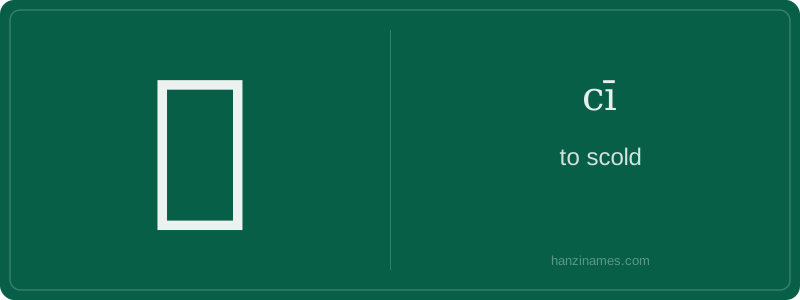
呲 is overwhelmingly used in spoken Mandarin and informal writing — especially in northern dialects and online slang — to depict sharp-tongued, mocking, or exaggerated scolding. It appears in fixed expressions like 呲儿巴喝 (cīr bā hē), meaning 'to berate loudly and rudely', documented in Beijing dialect dictionaries since the early 20th century. Literary scholar Li Rui notes its frequent use in Lao She’s Beijing-set novels to convey working-class verbal sparring. It’s absent from classical texts and formal registers.
The character has no oracle bone or bronze script attestation; it first appears in Ming–Qing vernacular literature as a phonetic-semantic compound. Its right side 此 was borrowed for sound (cī ≈ cǐ), not meaning. In daily life, Chinese speakers today might text '别呲我!' ('Don’t scold me like that!') to jokingly protest gentle teasing — revealing its modern softening into playful reproach.
Our detective begins at the scene: the character 呲 (cī), a sharp, nine-stroke glyph with 口 (mouth) as its radical. Its form is unmistakably vocal — the mouth radical signals speech or sound, while the right component, 此 (cǐ), originally meant 'this' but here serves phonetically. Unlike pictographic characters like 日 (sun), 呲 is a phono-semantic compound: sound + function. Its sharp 'cī' pronunciation mimics the hissing, grating quality of scolding — an onomatopoeic layer embedded in its design.
Zooming in on historical records, 呲 appears in late imperial vernacular texts and Qing dynasty novels (e.g., *The Scholars*), always paired with loud, contemptuous speech — never quiet reprimand. It conveys visceral disapproval: teeth-bared, voice raised, often in public or familial friction. Linguists note it’s rarely used alone; it thrives in reduplicative forms like 呲呲 or compound verbs such as 呲儿巴喝, reinforcing its performative, almost theatrical nature in oral expression.
Modern usage reveals a subtle shift: while still meaning 'to scold', 呲 now carries colloquial, slightly rustic or humorous overtones — think of a grandmother ‘scolding’ her grandchild with mock severity. It’s absent from formal writing and HSK curricula (hence no official HSK level), signaling its status as a vivid, register-specific term. Our detective concludes: this isn’t just ‘scolding’ — it’s scolding with sound, attitude, and social texture, preserved precisely because it captures something dictionaries struggle to define: the acoustic grit of human disapproval.
Example Sentences
Common Compounds
Similar Characters — Don't Mix These Up
Your First Step into Chinese Culture: Get a Chinese Name
Every journey into Chinese begins with a name. Use our free Chinese name generator to create a meaningful, personalized Chinese name that fits you perfectly.
Get My Chinese Name →