咅
Character Story & Explanation
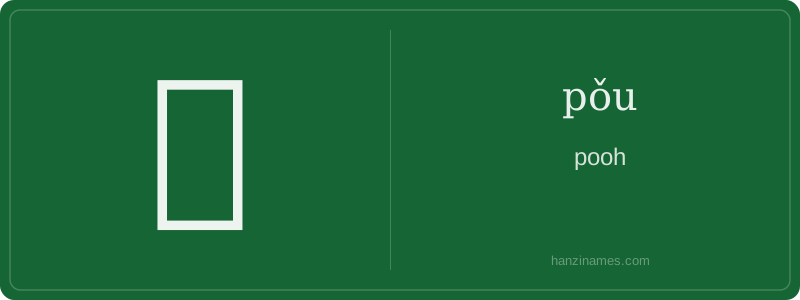
咅 is virtually unused in contemporary spoken or written Mandarin. It does not appear in the HSK vocabulary lists, modern textbooks, or mainstream corpora. No idioms, fixed phrases, or common compounds contain 咅. Historical records show it appears only in pre-modern rhyme dictionaries (e.g., the 12th-century Jiyun) as a phonetic variant for the syllable 'pǒu', primarily serving as a fanqie spelling component — not as an independent word. Today, it has no functional role in daily communication.
The character’s form combines 口 (mouth radical) with 否 (fǒu, 'no') — a clear phono-semantic compound: 口 indicates oral sound, 否 provides both pronunciation (historical *pʰəu > pǒu) and semantic association with negation or rejection. This structure reflects standard Han dynasty character formation principles, not pictographic origin.
咅 (pǒu) is a rare, onomatopoeic character representing the sound 'pooh' — a dismissive or contemptuous exhalation. Unlike common interjections like 哼 (hng) or 哼 (hēng), 咅 carries an archaic, almost literary flavor, evoking classical disdain rather than casual annoyance. Its very rarity reflects the Chinese linguistic preference for expressive context over isolated sound-symbols — meaning tone, facial expression, and phrasing often convey dismissal more powerfully than any single character.
This character embodies a subtle cultural principle: restraint in verbal expression. In Confucian-influenced communication, overt mockery or scorn is discouraged; thus, 咅 appears not in everyday speech but in historical texts or satirical writing where stylized disdain serves rhetorical purpose. Its existence affirms that Chinese orthography preserves nuanced vocal gestures — even marginal ones — as part of its semantic ecology.
While modern Mandarin speakers rarely utter 'pǒu' aloud as a standalone word, the character survives in dictionaries and classical references as a lexical fossil — a reminder that language encodes not just meaning, but attitude, posture, and social boundary. To encounter 咅 is to glimpse how Chinese script captures the physics of breath-as-judgment: a sharp, closed-mouth expulsion signifying rejection without argument.
Example Sentences
Common Compounds
Similar Characters — Don't Mix These Up
Your First Step into Chinese Culture: Get a Chinese Name
Every journey into Chinese begins with a name. Use our free Chinese name generator to create a meaningful, personalized Chinese name that fits you perfectly.
Get My Chinese Name →