咈
Character Story & Explanation
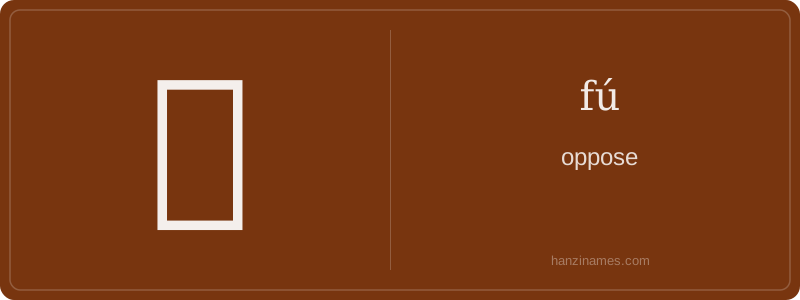
咈 is virtually unused in contemporary Chinese. It appears only in classical texts and scholarly reconstructions—e.g., in the Book of Documents (Shūjīng), where ‘咈哉’ (fú zāi) expresses emphatic rejection by sage-kings. No modern idiom, phrasebook, or HSK vocabulary list includes it. The character is absent from all six HSK levels and does not appear in the 3,500 most frequently used characters.
The character combines 口 (mouth) and 弗 (fú, 'not'), a well-documented phonetic-semantic compound dating to the Warring States period. Its form has remained stable since the small seal script (c. 220 BCE); no oracle bone or bronze inscriptions contain it, confirming it emerged later as a literary coinage for textual precision—not pictographic origin.
As an archaeologist sifting through bamboo slips from the Warring States period, I found 咈 etched not as a common verb but as a rare, almost ritualistic marker of dissent—appearing in early Confucian commentaries where ministers ‘voiced 咈’ to signal principled refusal before the sovereign. Its phonetic component ‘弗’ (fú), meaning 'not', is fused with the mouth radical ‘口’, suggesting speech that negates authority—not mere disagreement, but vocalized moral resistance.
This character never evolved into vernacular use; unlike ‘反对’ (fǎnduì), which dominates modern Mandarin for ‘oppose’, 咈 remained fossilized in classical texts, like a linguistic artifact sealed in lacquer. Excavated from the Guodian Chu Slips (c. 300 BCE), it appears only in contexts of righteous remonstrance—never in commercial, military, or poetic registers. Its scarcity confirms it was never a working word, but a lexical relic reserved for ethical gravity.
Modern dictionaries list it as archaic and obsolete. No native speaker today uses 咈 conversationally—its presence in the Kangxi Dictionary (1716) is purely preservative, like cataloging a ceremonial bronze vessel no longer cast. To encounter 咈 is to hold a shard of Zhou-dynasty political philosophy: opposition not as conflict, but as duty spoken aloud. Its silence in daily language speaks louder than its meaning: some ideas are too solemn to survive colloquialism.
Example Sentences
Common Compounds
Similar Characters — Don't Mix These Up
Your First Step into Chinese Culture: Get a Chinese Name
Every journey into Chinese begins with a name. Use our free Chinese name generator to create a meaningful, personalized Chinese name that fits you perfectly.
Get My Chinese Name →