咎
Character Story & Explanation
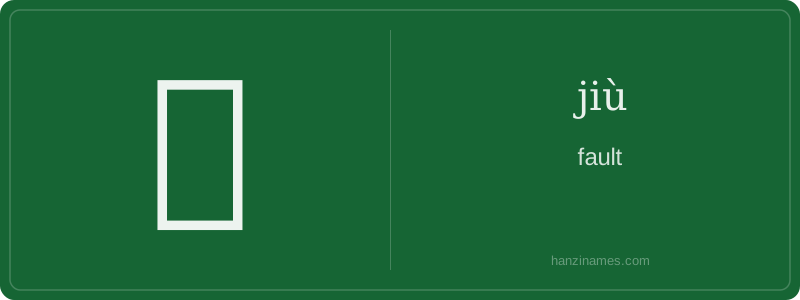
咎 appears frequently in classical and modern formal registers: in legal documents (e.g., 刑事责任追究, 'pursuit of criminal liability'), historical analyses (e.g., 亡国之咎, 'the fault leading to dynastic collapse'), and idioms like 既往不咎 (jì wǎng bù jiù)—'past faults are not held against you,' a cornerstone phrase in diplomacy and reconciliation. It’s used in official media when assigning institutional accountability, never in light-hearted banter.
The character’s earliest attested form is in bronze inscriptions (c. 11th–3rd century BCE), where it combines 口 (mouth/speech) and 处 (archaic variant of 处, implying 'to dwell' or 'to place')—not a pictograph, but a semantic-phonetic compound. Its structure reflects how fault was linguistically 'placed' and 'pronounced' within ritual and administrative discourse.
咎 (jiù) embodies a deeply Confucian sensibility: fault is not merely an error to be punished, but a relational rupture demanding introspection and restoration. Unlike Western notions of blame that often isolate the individual, 咎 implies responsibility embedded in hierarchy and duty—whether as ruler, parent, or scholar. Its presence in classical texts like the *Book of Documents* underscores how moral accountability was woven into governance and kinship.
The radical 口 (mouth) signals speech-related consequences—faults revealed through confession, accusation, or official pronouncement—not silent misdeeds. This reflects a worldview where language carries ethical weight: naming fault is the first step toward rectification. In imperial examinations and legal edicts, 咎 marked formal censure, linking verbal acknowledgment with social reintegration.
Modern usage retains this gravity: 咎 is rarely casual slang but appears in solemn contexts—legal verdicts, historical retrospectives, or self-critical essays. It evokes humility before collective standards, not shame before abstract law. To ‘accept 咎’ is to honor harmony over ego, making it a quiet compass for ethical navigation in Chinese thought.
Example Sentences
Common Compounds
Similar Characters — Don't Mix These Up
Your First Step into Chinese Culture: Get a Chinese Name
Every journey into Chinese begins with a name. Use our free Chinese name generator to create a meaningful, personalized Chinese name that fits you perfectly.
Get My Chinese Name →