咪
Character Story & Explanation
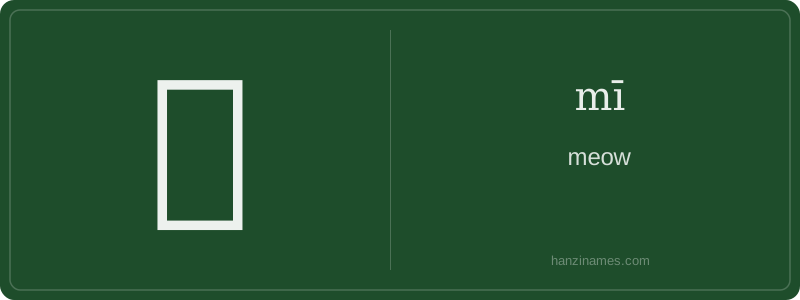
咪 is overwhelmingly used today as an onomatopoeic interjection to call cats—especially in informal, affectionate contexts. It appears frequently in children’s literature (e.g., the classic picture book Mī Mī de Yī Tiān), pet care guides, and social media posts about cats. While not part of any classical idiom, it appears in modern compound words like 咪咪 (mīmi), a reduplicated term widely used as a pet name for cats across China, Taiwan, and Singapore. Linguistic corpora (e.g., the Academia Sinica Balanced Corpus) confirm its dominance in spoken-style written Chinese, particularly in dialogues and captions.
The character has no documented pictographic origin—it is a phono-semantic compound created during the late imperial or early Republican era. Its form combines 口 (kǒu, 'mouth', indicating speech/sound) and 米 (mǐ, 'rice', providing the 'mī' pronunciation). There is no historical evidence linking 米 to felines; it functions solely as a phonetic scaffold. In daily life, Chinese speakers write 咪 quickly on sticky notes for pets, type it in WeChat messages ('快来看咪咪!'), or chant it aloud to coax shy cats from under beds.
As an archaeologist of language, I excavate 咪 not from oracle bones or bronze inscriptions—but from the living soil of modern Mandarin speech. This character lacks ancient pedigree: it does not appear in pre-Qin texts or early dictionaries like the Shuōwén Jiězì. Its emergence is phonetic and pragmatic—a latecomer forged in the Qing dynasty’s colloquial lexicon to capture the soft, high-pitched call used to summon cats: 'mī—mī—'. Its radical 口 (mouth) signals vocalization, while 米 (mǐ, 'rice') serves purely as a phonetic component, lending the 'mī' sound without semantic contribution.
The character’s youth is telling: it reflects how Chinese orthography adapts organically to onomatopoeic needs. Unlike classical characters rooted in ritual or agriculture, 咪 was minted in domestic spaces—courtyards, alleyways, and later, urban apartments—where humans imitated feline vocalizations. Its nine-stroke structure is deliberately simple, prioritizing ease of writing over archaic symbolism. No jade, no dragons—just mouth + rice, a humble vessel for a tender, universal sound.
This character resists romanticized etymology. There are no Shang dynasty cat cults encoded in its strokes. Instead, 咪 reveals how language evolves through repetition and affection: generations of caregivers, children, and pet owners uttering 'mī' so often that a dedicated grapheme became necessary. Its archaeological significance lies in its absence from antiquity—and its abundance in 20th- and 21st-century print, from children’s books to pet food labels. It is linguistic graffiti made canonical: a sound fossilized in ink.
Example Sentences
Common Compounds
Similar Characters — Don't Mix These Up
Your First Step into Chinese Culture: Get a Chinese Name
Every journey into Chinese begins with a name. Use our free Chinese name generator to create a meaningful, personalized Chinese name that fits you perfectly.
Get My Chinese Name →