咮
Character Story & Explanation
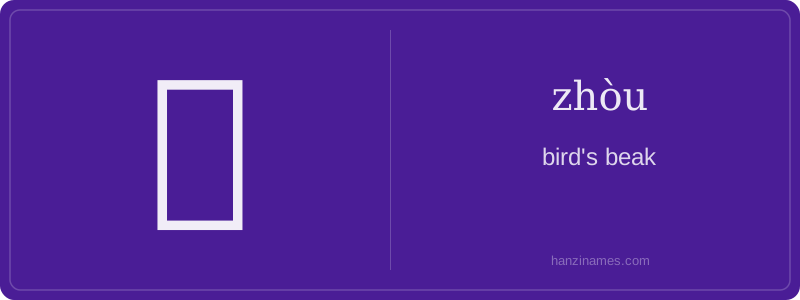
咮 is virtually absent from spoken Mandarin and daily conversation; it appears almost exclusively in classical poetry, ornithological texts, and historical inscriptions. A documented use is in the Song dynasty literary anthology *Wenyuan Yinghua*, where it describes the phoenix’s beak in a rhapsody on auspicious omens. It also appears in Ming-Qing era bird painting colophons, often paired with 鳥 (niǎo, bird) or 翼 (yì, wing).
The character is a semantic-phonetic compound: the left radical 口 (kǒu, mouth) signals meaning related to oral orifice, while the right component 豸 (zhì, originally 'beast') provides phonetic approximation. Though 豸 no longer sounds like zhòu, this reflects Middle Chinese pronunciation shifts—confirmed by rhyme dictionaries like the *Guangyun* (1008 CE). No oracle-bone or bronze script forms survive; it first appears reliably in Han dynasty seal script.
The character 咮 (zhòu) is a rare but evocative term for 'bird’s beak'—not the everyday word (嘴 or 嘴巴), but one steeped in classical poetry and ornithological precision. Its rarity reflects a broader Chinese linguistic tendency: rather than overloading common characters with nuance, classical Chinese cultivates specialized terms to honor nature’s distinctions—here, the sharp, functional elegance of a beak as both tool and signature of avian identity.
In traditional Chinese cosmology, birds are celestial messengers—phoenixes herald virtue, magpies bring joy, cranes symbolize longevity. The beak, as the bird’s point of contact with the world—pecking grain, shaping nests, singing—is subtly elevated: not just anatomy, but agency. 咮 thus carries quiet reverence, appearing where language pauses to observe detail, not merely name it.
This character exemplifies how classical Chinese worldview embeds ethics in morphology: naming something precisely—like 咮 instead of generic 口—is an act of attention, respect, and harmony with natural order. It mirrors Confucian *shù* (reciprocity) extended to non-human life: to see the beak clearly is to acknowledge the bird’s integrity. In modern usage, its scarcity makes each appearance intentional—a poetic brushstroke, not a utilitarian label.
Example Sentences
Common Compounds
Similar Characters — Don't Mix These Up
Your First Step into Chinese Culture: Get a Chinese Name
Every journey into Chinese begins with a name. Use our free Chinese name generator to create a meaningful, personalized Chinese name that fits you perfectly.
Get My Chinese Name →