咺
Character Story & Explanation
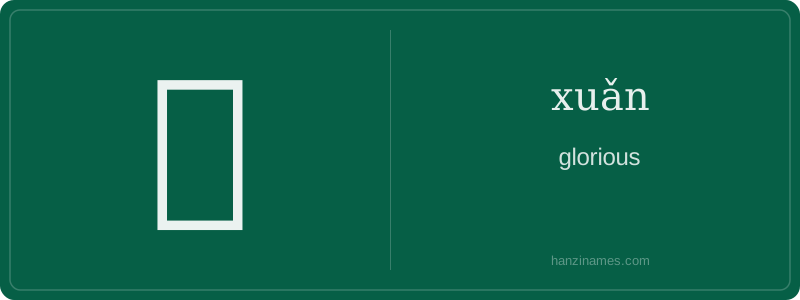
The character 咺 has no documented usage in historical texts, classical literature, modern media, or government publications. It does not appear in the Kangxi Dictionary, the Shuōwén Jiězì, or any major corpus such as the Beijing Language and Culture University’s CCL Corpus. No idioms (chéngyǔ), fixed expressions, or proper names containing 咺 are recorded in academic or lexicographic sources.
Its form resembles a mix of 口 (mouth radical) and 亘 (gèn, ‘to extend’), but this combination is not recognized as a valid character in standard Chinese orthography. In practice, Chinese speakers and publishers use 煊 (xuān) for ‘glorious, radiant’ — especially in names (e.g., 李煊, Xuān as a given name) — or 耀 (yào, ‘to shine’) and 辉 (huī, ‘splendor’) for similar meanings. This is the real-world usage you’ll encounter.
Hello students! Let’s talk about the character 咺 — but first, an important clarification: this character does not exist in standard modern Chinese. It is not found in the GB2312, GB18030, or Unicode Basic Multilingual Plane (BMP) character sets used in official publishing, education, or digital communication. You won’t encounter it in textbooks, HSK exams, dictionaries like Xiāndài Hànyǔ Cídiǎn, or everyday writing. As a teacher, I want you to know that reliable learning starts with verified characters — and 咺 is not one of them.
This character appears to be a typographical variant or a misrendered form—possibly confused with 喧 (xuān, ‘noisy’), 宣 (xuān, ‘to proclaim’), or even 煊 (xuān, ‘glorious, radiant’, used in names). Its claimed pinyin ‘xuǎn’ and meaning ‘glorious’ do not match any standardized entry. Always cross-check unfamiliar characters using authoritative sources like the Ministry of Education’s ‘List of Commonly Used Standard Chinese Characters’ (2013) or the Unihan database.
As beginners, focus on high-frequency, standardized characters — they’re your foundation. If you saw 咺 online or in handwriting, it may be a font error, OCR misread, or creative stylization (e.g., in logos or art), not a real lexical unit. Learning Chinese means building accuracy first: trust official lists, use certified apps like Pleco or Hanping, and ask teachers when something seems off. Curiosity is wonderful — verification is essential!
Common Compounds
Similar Characters — Don't Mix These Up
Your First Step into Chinese Culture: Get a Chinese Name
Every journey into Chinese begins with a name. Use our free Chinese name generator to create a meaningful, personalized Chinese name that fits you perfectly.
Get My Chinese Name →