试
Character Story & Explanation
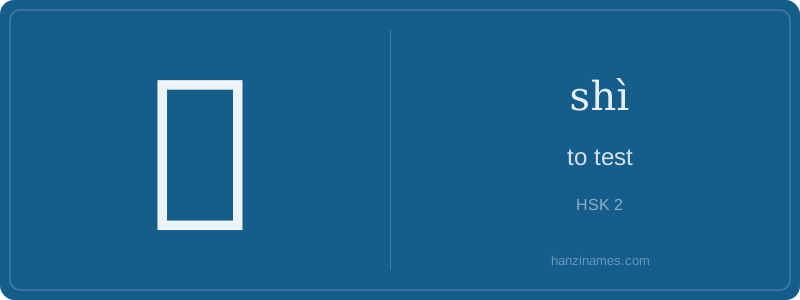
In modern China, 试 is ubiquitous in education, commerce, and tech. Students take 模拟考试 (mó nǐ kǎo shì, mock exams) before Gaokao; shoppers say 我试试 (wǒ shì shi, 'I’ll try it on') in clothing stores; and apps display 试用版 (shì yòng bǎn, 'trial version'). The idiom 小试牛刀 (xiǎo shì niú dāo, 'to test one’s skill on a small scale') originates from the Ming dynasty and remains common in business contexts to describe a preliminary demonstration of ability.
The character 试 is a phono-semantic compound: the left radical 讠 ('speech') indicates its semantic field (communication-related action), while the right component 式 (shì, 'formula, pattern') provides pronunciation and hints at structured procedure. First attested in bronze inscriptions of the Warring States period (475–221 BCE), it evolved from earlier forms meaning 'to examine according to established norms' — confirming its longstanding link to standardized evaluation.
The character 试 (shì) embodies the active, practical spirit of inquiry in Chinese culture — not passive observation, but deliberate, hands-on testing. With its speech radical (讠), it signals that testing often begins with verbal instruction, explanation, or a stated goal: a teacher says 'Let’s try this,' a technician reads specs aloud, or a chef announces a new recipe test. This reflects how knowledge in Chinese pedagogy and craftsmanship is validated through action guided by communication.
At eight strokes, 试 is elegantly compact — a testament to Chinese writing’s efficiency. Its structure balances clarity and motion: the left side (讠) grounds it in language and intention; the right side (式) means ‘formula,’ ‘pattern,’ or ‘ceremonial form,’ implying that testing follows a method or standard. This duality — speech + system — mirrors real-world applications like quality control in Shenzhen factories or trial lessons at Beijing language schools.
As an HSK Level 2 character, 试 appears early because it unlocks essential verbs and nouns for daily interaction: trying on clothes, taking practice exams, sampling food, or launching beta software. It carries neutral-to-positive connotations — rarely implies failure, but rather respectful effort and openness to learning. In Confucian-influenced education, ‘testing’ is not judgmental, but a step toward self-cultivation and mastery — making 试 a quietly profound word in everyday life.
Example Sentences
Common Compounds
Similar Characters — Don't Mix These Up
Your First Step into Chinese Culture: Get a Chinese Name
Every journey into Chinese begins with a name. Use our free Chinese name generator to create a meaningful, personalized Chinese name that fits you perfectly.
Get My Chinese Name →