咿
Character Story & Explanation
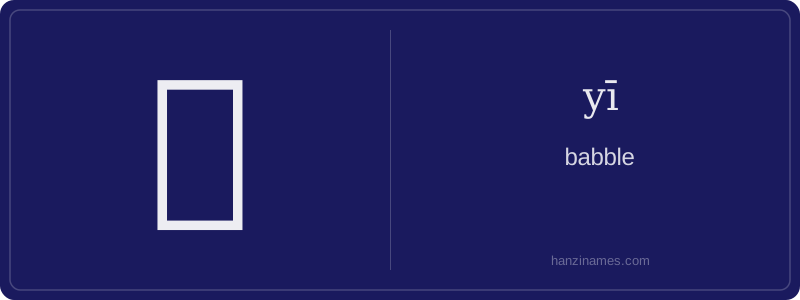
咿 is rarely used alone in modern Standard Mandarin; instead, it appears almost exclusively in the reduplicated phrase 咿咿呀呀 (yī yī yā yā), describing infant babbling or incoherent, endearing vocalizations. It appears in educational materials for early childhood development, parenting blogs, and literary depictions of newborns or dementia patients—e.g., in Lu Xun’s essays referencing children’s pre-linguistic sounds. No major idioms or classical texts feature 咿 as a standalone word; its usage is strictly phonetic and contextual.
The character is not pictographic nor derived from oracle bone inscriptions. Its form combines 口 (mouth, radical) with 伊 (yī, a phonetic component, also meaning 'that' or used as a pronoun). The 伊 component provides pronunciation and has no semantic link to squeaking—making 咿 a classic phono-semantic compound. Today, Chinese parents and caregivers commonly write or say 咿咿呀呀 when documenting or mimicking babies’ earliest vocal play.
The character 咿 (yī) is an onomatopoeic syllable representing a high-pitched, soft, often infantile or involuntary vocal sound—like a baby’s first breathy utterance or the faint creak of a rusty hinge. Unlike English ‘squeak’, which implies sharpness and tension (e.g., sneakers on a gym floor), 咿 conveys gentleness, fragility, and nascent expression. It appears almost exclusively in reduplicated forms (e.g., 咿咿呀呀) to mimic babbling, emphasizing rhythm over semantic weight.
In Chinese phonetics, 咿 belongs to the ‘mouth’ (口) radical family, anchoring it firmly in vocalization—not meaning-based ideography. Its nine strokes include three horizontal lines and two vertical strokes framing the mouth, visually echoing open-mouthed emission. Though not an HSK-listed character (it's rare in formal writing), it thrives in literary description, childcare contexts, and dialectal speech where authenticity of sound matters more than lexical precision.
Western equivalents like 'coo', 'goo', or 'goo-goo' come closest—but lack 咿’s tonal specificity and cultural resonance. In English nursery rhymes, we say 'goo-goo gah-gah'; in Mandarin, it’s 咿咿呀呀 (yī yī yā yā), a rhythmic, tonally balanced phrase that mirrors the melodic contour of infant-directed speech across Sinitic languages. This reflects a broader linguistic tendency: Chinese favors reduplication and tone-play for expressive sound-imitation, while English leans on consonant clusters ('squ-', 'scree-') for intensity.
Example Sentences
Common Compounds
Similar Characters — Don't Mix These Up
Your First Step into Chinese Culture: Get a Chinese Name
Every journey into Chinese begins with a name. Use our free Chinese name generator to create a meaningful, personalized Chinese name that fits you perfectly.
Get My Chinese Name →