哃
Character Story & Explanation
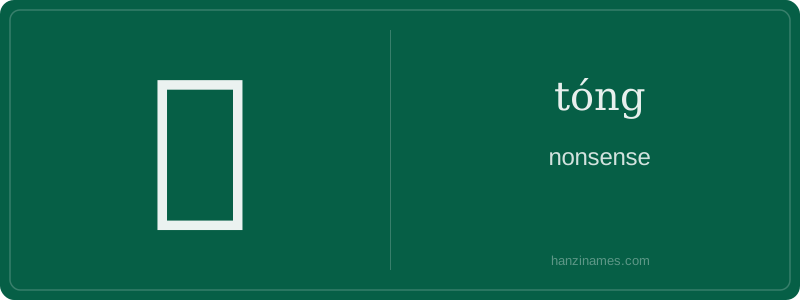
哃 is virtually absent from formal writing, dictionaries, and standardized tests—including all HSK levels—and does not appear in the Xiàndài Hànyǔ Cídiǎn (7th ed., 2016) or the GB 2312/18030 character sets. It is not encoded in Unicode’s Basic Multilingual Plane (BMP) and is excluded from official education curricula. Instead, it circulates informally in digital spaces: Weibo comments, Douyin captions, and gaming chat, where users type it phonetically (tóng) to mock hollow claims, corporate slogans, or political platitudes.
This character has no documented historical origin—it is not found in oracle bone, bronze, or seal scripts, nor in classical texts. Linguists classify it as a modern, orthographic coinage: a phonetic loan using the mouth radical (口) + 同 (tóng) purely for sound, not meaning. Its written form emerged organically online to represent an existing spoken interjection, not as a revived ancient glyph.
The character 哃 (tóng) is a rare, colloquial Chinese interjection used to express disbelief or dismissal of nonsense—akin to saying 'Rubbish!' or 'Don’t give me that!' in English. It carries strong pragmatic force, functioning not as a verb but as a discourse particle signaling rejection of illogical, absurd, or insincere speech. Unlike standard verbs for 'to lie' or 'to babble', 哃 is emphatically informal and often appears in spoken Mandarin, especially in northern dialects and online slang.
Western equivalents include English expressions like 'Nonsense!', 'Poppycock!', or 'Get out of here!', which similarly serve as exclamatory rejections rather than descriptive statements. These share 哃’s pragmatic role: they interrupt, refute, and emotionally punctuate dialogue—not to define truth but to assert social boundaries around acceptable reasoning. Like 'Baloney!' in American English, 哃 is performative, relying on tone and context more than literal semantics.
Culturally, 哃 reflects a distinctly Chinese rhetorical tradition where language policing—especially against flattery, empty rhetoric, or face-saving evasion—is socially valued. It echoes classical concepts like 直言 (zhíyán, 'speaking frankly') and contrasts with Confucian ideals of diplomatic restraint. Yet its modern usage is decidedly anti-pretentious: it’s the linguistic equivalent of rolling one’s eyes, widely embraced in internet forums and youth media as a marker of authenticity and critical awareness.
Example Sentences
Common Compounds
Similar Characters — Don't Mix These Up
Your First Step into Chinese Culture: Get a Chinese Name
Every journey into Chinese begins with a name. Use our free Chinese name generator to create a meaningful, personalized Chinese name that fits you perfectly.
Get My Chinese Name →