哏
Character Story & Explanation
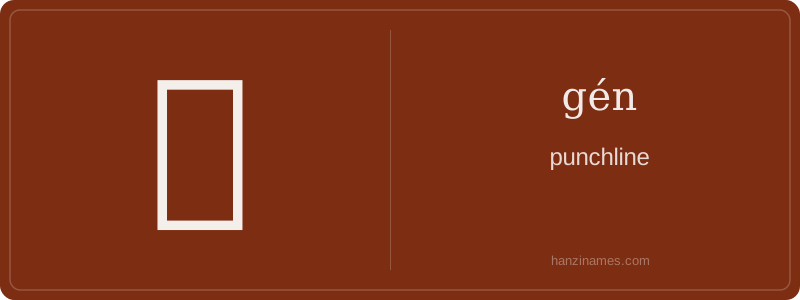
哏 is primarily used in the context of Chinese comedic performance, especially xiangsheng (crosstalk), where it denotes a humorous line, punchline, or comedic device. Documented since at least the early 20th century in Beijing and Tianjin performance scripts, it appears in terms like '捧哏' (pěnggén, 'straight man') and '逗哏' (dòugén, 'comic lead') — roles central to crosstalk duos. Linguists confirm its origin as a phonetic loan character (not pictographic), likely derived from colloquial pronunciation of words meaning 'to mock' or 'to tease' in northern dialects.
The character itself isn’t ancient — no oracle bone or seal script forms exist. Its written form (口 + 亘) was standardized in the 20th century for consistency in performance texts. Today, young Chinese use 哏 online to label funny memes or ironic remarks — e.g., '这个哏我get了' ('I got this joke') — making it a living, evolving part of digital vernacular.
Hi there! Let’s explore the character 哏 (gén). Though it looks simple, it’s a fascinating case of regional language meeting modern internet culture. It’s not an official HSK character — you won’t find it in standard textbooks or exams — but it’s widely recognized in spoken and online Mandarin, especially in northern China and among comedians. Its core meaning is 'funny' or 'a humorous line/remark', often referring to the punchline of a joke or a witty remark that makes people laugh.
This character belongs to the 口 (kǒu, 'mouth') radical — fitting, since humor lives in speech! With just 9 strokes, it’s easy to write, but its usage is highly contextual: it’s almost never used alone in formal writing. Instead, it appears in compound words like 相声哏 (xiàngsheng gēn) — the comedic material in traditional crosstalk — or in internet slang like ‘这哏太老了’ ('This joke is too outdated').
Don’t confuse it with the common word 很 (hěn, 'very') — though they sound similar when mispronounced, they’re unrelated in origin and meaning. 哏 is informal, performative, and deeply tied to oral tradition. Think of it as the Chinese equivalent of 'the bit' in English comedy slang — not the whole joke, but the *funny part* that lands. Mastering it helps you understand real, lively Chinese — especially stand-up, variety shows, and meme culture!
Example Sentences
Common Compounds
Similar Characters — Don't Mix These Up
Your First Step into Chinese Culture: Get a Chinese Name
Every journey into Chinese begins with a name. Use our free Chinese name generator to create a meaningful, personalized Chinese name that fits you perfectly.
Get My Chinese Name →