哤
Character Story & Explanation
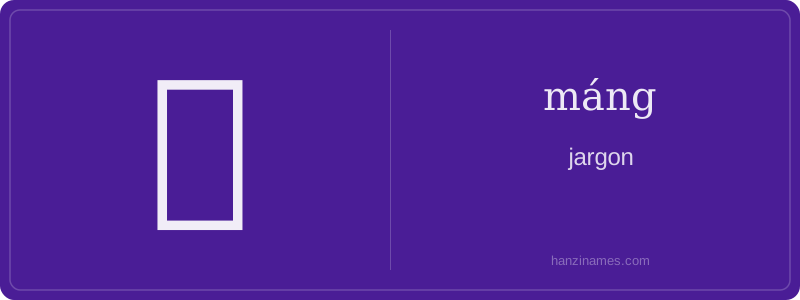
哤 is virtually unused in modern spoken or written Chinese. It appears only in pre-20th-century literary texts — notably in Qing dynasty essays and classical poetry — where it functions as a stylistic intensifier for meaningless or confusing speech. No idioms (chengyu), dictionary entries in the Xinhua Zidian, or HSK wordlists include it; even the authoritative Chinese Character Dictionary (《汉语大字典》) lists it as archaic and obsolete. It has no role in education, media, or daily communication.
The character’s form combines 口 (mouth) and 亡 (wáng, 'to perish'), suggesting 'speech that dies before comprehension' — a documented semantic rationale found in late imperial philological commentaries. While not pictographic, this ‘mouth + perish’ composition reflects classical Chinese logographic logic: abstract meaning derived from component semantics, not visual depiction.
The character 哤 (máng) is a rare, literary term meaning 'jargon' or 'specialized, incomprehensible speech' — often with a negative connotation of obscurity or pretentiousness. It appears almost exclusively in classical or formal written Chinese, not in spoken vernacular. Its rarity means it’s absent from most modern dictionaries and learner resources, contributing to its near-invisibility in contemporary usage.
Linguistically, 哤 belongs to the ‘mouth’ radical (口) category, signaling its connection to speech, but unlike common mouth-radical characters (e.g., 叫, 吃), it carries no phonetic component that reliably hints at its pronunciation máng — making it an irregular, non-phonosemantic compound. This structural opacity reinforces its status as a fossilized lexical item rather than a productive morpheme.
Despite its definition as 'jargon', 哤 does not refer to technical terminology per se (like 计算机术语, jìsuànjī shùyǔ), but rather to speech that is deliberately obscure, garbled, or nonsensical — akin to 'gibberish' or 'babble' in English. It’s often paired with characters like 哗 (huá) or 哮 (xiào) in classical collocations to evoke chaotic, unintelligible noise — underscoring its emotive, stylistic function over semantic precision.
Example Sentences
Common Compounds
Similar Characters — Don't Mix These Up
Your First Step into Chinese Culture: Get a Chinese Name
Every journey into Chinese begins with a name. Use our free Chinese name generator to create a meaningful, personalized Chinese name that fits you perfectly.
Get My Chinese Name →