哮
Character Story & Explanation
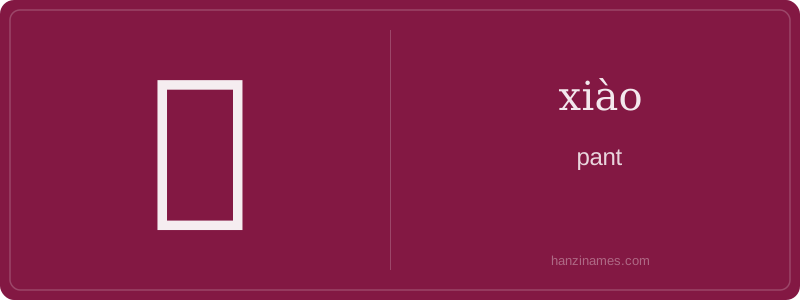
In modern Chinese, 哮 appears almost exclusively in medical and literary contexts—not daily conversation. It’s central to the clinical term 哮喘 (xiāo chuǎn, 'asthma'), a compound documented in Song-dynasty medical manuals and now standard in China’s National Health Commission guidelines. The idiom 哮天犬 (xiāo tiān quǎn, 'Heaven-barking Hound') references Erlang Shen’s mythical dog in *Journey to the West*, symbolizing fierce, resonant barking—showing how the character extends from human panting to supernatural vocalization.
The character is not pictographic. Its form evolved from seal script (c. 3rd c. BCE), where 口 and 孝 were already combined phonosemantically. No oracle bone or bronze inscription contains 哮—it’s a later, literate-era creation. Today, Chinese learners encounter it first in health education or literature classes, often alongside asthma awareness campaigns or classical novel excerpts.
As an archaeologist sifting through layers of linguistic sediment, I find 哮 not in oracle bones—but in the breathless margins of classical medical texts and Ming-Qing vernacular fiction. Its earliest attested uses (e.g., in the 16th-century *Bencao Gangmu*) describe pathological panting—labored, audible respiration linked to lung disorders or emotional distress. The character’s oral radical 口 signals its visceral, sound-based nature: this is not silent breathing, but a vocalized, strained exhalation.
The ten-stroke structure reveals deliberate phonosemantic design: 口 (mouth) anchors meaning, while 孝 (xiào, 'filial piety') serves as the phonetic component—a common strategy in later-character formation. Crucially, 孝 here contributes only sound, not meaning; early scholars like Duan Yucai noted this phonetic borrowing explicitly. No ancestral ritual or filial sigh connects the two—just historical sound alignment.
Unlike pictographic characters carved from observation (like 日 or 山), 哮 emerged from systematic character creation during the Warring States to Han periods. It reflects a shift toward abstraction: representing internal physiological states through sound + body-part radicals. Its persistence across millennia—from Tang poetry describing wounded warriors ‘哮喘不止’ to modern clinical diagnoses—testifies to its precise semantic niche: the audible, distressed pant, distinct from ordinary breathing or shouting.
Example Sentences
Common Compounds
Similar Characters — Don't Mix These Up
Your First Step into Chinese Culture: Get a Chinese Name
Every journey into Chinese begins with a name. Use our free Chinese name generator to create a meaningful, personalized Chinese name that fits you perfectly.
Get My Chinese Name →