唁
Character Story & Explanation
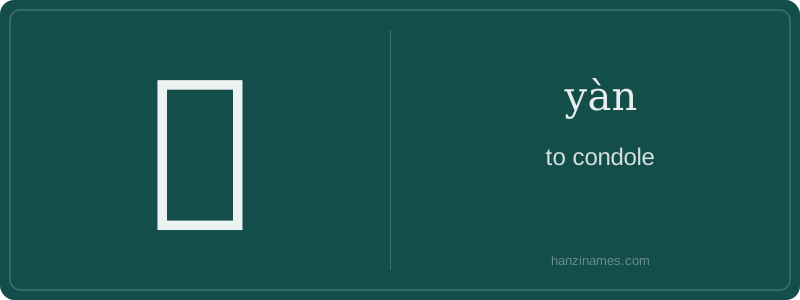
In modern China, 唁 appears almost exclusively in formal, written condolences: official letters from government agencies, corporate statements after employee deaths, and obituary notices in newspapers like the People’s Daily. It rarely occurs in spoken conversation—people say 安慰 (ānwèi, 'comfort') or 节哀 (jié'āi, 'restrain your grief') instead. The phrase 吊唁 (diàoyàn) is standard in news reports and funeral announcements, meaning 'to pay respects at a funeral'. Its usage remains strictly formal and somber.
The character’s structure is phonosemantic: 口 (kǒu, 'mouth') is the semantic component indicating speech-related meaning, while 言 (yán) serves as both semantic reinforcement and phonetic hint (yàn and yán share the same initial and tone family). No oracle-bone or bronze inscriptions of 唁 survive—it first appears reliably in Han dynasty clerical script texts, confirming its late emergence as a specialized mourning term.
Unearthing 唁 (yàn) feels like brushing dust from a Han dynasty bamboo slip—its form preserves the ritual gravity of ancient mourning. The 口 (mouth) radical signals speech, not casual talk, but solemn, formulaic utterance: words spoken with bowed head at a funeral or in a condolence letter. This isn’t spontaneous grief—it’s culturally encoded verbal respect, codified over two millennia.
The right side, 言 (yán), meaning 'to speak', is itself a pictograph evolved from oracle-bone script showing a mouth and tongue. Combined with 口, 唁 doubles down on vocalized ritual—speech as ceremonial act. Its 10 strokes aren’t arbitrary; each mirrors the measured pace of mourning rites: deliberate, restrained, never rushed.
This character never appears in joyful contexts. Even in modern usage, it carries the hush of a funeral hall. Archaeologically, its consistency across texts—from Tang steles to Ming epitaphs—reveals how deeply Chinese civilization ties language to ethical duty. To 唁 is not just to say ‘I’m sorry’—it’s to perform a moral posture through speech, one that has endured unchanged longer than most written languages.
Example Sentences
Common Compounds
Similar Characters — Don't Mix These Up
Your First Step into Chinese Culture: Get a Chinese Name
Every journey into Chinese begins with a name. Use our free Chinese name generator to create a meaningful, personalized Chinese name that fits you perfectly.
Get My Chinese Name →