唅
Character Story & Explanation
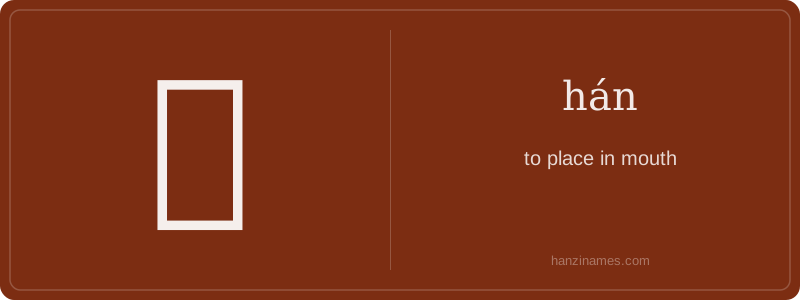
唅 is rarely used in modern spoken Mandarin but retains documented ceremonial significance, especially in classical texts and historical burial practices. The Rites of Zhou (Zhou Li) and Han dynasty archaeological reports confirm its use in mortuary rites—e.g., placing jade cicadas (玉琀, yù hán) in the mouth of nobles to symbolize rebirth and purity. Today, it appears almost exclusively in literary, academic, or ritual contexts, such as museum descriptions of ancient tombs or scholarly discussions of Han dynasty customs.
The character is not pictographic; its form combines 口 (mouth, radical) and 含 (hán, ‘to hold in the mouth’—a phonetic-semantic compound). While 含 itself evolved from oracle-bone script depicting a mouth with something inside, 唅 is a variant or archaic form emphasizing ritual insertion—seen in bronze inscriptions and early dictionaries like the Shuowen Jiezi (100 CE), which defines it as ‘placing objects in the mouth of the deceased.’
唅 (hán) is a subtle yet culturally resonant character that reflects the Chinese worldview’s deep attention to embodied action and ritual intentionality. Unlike English verbs like 'put' or 'place,' 唅 specifically denotes inserting something into the mouth—not for eating, but for preservation, reverence, or symbolic transition. This precision reveals how classical Chinese thought distinguishes physical acts by their purpose and context: a gesture becomes meaningful only when aligned with ethical or cosmological roles.
In traditional funerary rites, 唅 carried profound metaphysical weight: placing jade, coins, or rice in the deceased’s mouth was believed to sustain the soul’s journey and affirm continuity between life and afterlife. The mouth—radical 口—is not merely an orifice but a threshold; thus 唅 embodies the Daoist and Confucian ideal of *li* (ritual propriety), where even minute bodily actions uphold cosmic harmony and filial duty.
This character quietly challenges Western dualisms of body/mind or secular/sacred. To 唅 is to enact care through the body—tactile, deliberate, reverent. It reminds us that in Chinese tradition, meaning isn’t abstracted from gesture; it resides *in* the careful placement of an object at the boundary of breath and silence. In this light, 唅 is less about ingestion than about intention made visible—a cultural window into how language encodes reverence in motion.
Example Sentences
Common Compounds
Similar Characters — Don't Mix These Up
Your First Step into Chinese Culture: Get a Chinese Name
Every journey into Chinese begins with a name. Use our free Chinese name generator to create a meaningful, personalized Chinese name that fits you perfectly.
Get My Chinese Name →