唎
Character Story & Explanation
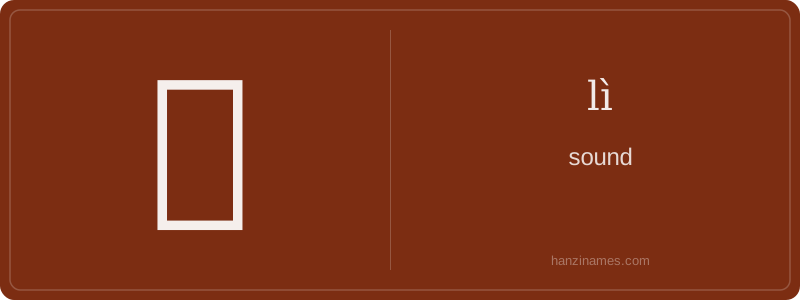
唎 (lì) is almost exclusively used in transliterated foreign words, especially historical ones. The most documented usage is in the obsolete term 唎噸 (lìdùn), an early 19th-century transliteration of 'ton' (unit of weight), appearing in Qing dynasty customs records and maritime trade documents. It also appears in older renderings of 'Liverpool' (利物浦, Lìpǔsāi) and 'Lisbon' (里斯本, Lǐsīběn)—though the first character there is usually 李 or 理, not 唎. Today, 唎 is virtually obsolete in spoken or written Chinese and does not appear in any modern HSK vocabulary list.
The character’s form combines 口 (kǒu, 'mouth') with 利 (lì, 'sharp/advantageous') as a phonetic component. It is not a pictograph or ancient ideograph; it was created during the late imperial period specifically for phonetic transcription—documented in Qing-era dictionaries like the Zìhuì Supplement (1716). No oracle bone or bronze script forms exist for 唎.
唎 (lì) is a phonetic-ideographic character primarily used to transcribe foreign words—especially names and sounds—into Chinese. Its 口 (mouth) radical signals a connection to speech or vocalization, while the right component 利 (lì, meaning 'sharp' or 'advantageous') serves mainly as a phonetic cue. Unlike common semantic characters, 唎 carries no independent meaning in modern Mandarin; it exists almost exclusively in transliterations.
This character exemplifies how Chinese adapts to linguistic globalization: instead of inventing new meanings, it repurposes existing forms for precise sound-matching. It appears in historical loanwords from English, Portuguese, and other languages—often preserving colonial-era pronunciations. Because it’s not part of daily vocabulary, learners rarely encounter it outside dictionaries or specialized contexts like historical texts or brand names.
While 唎 isn’t taught in HSK exams (HSK Level: Not included), its presence reveals China’s long-standing practice of phonetic borrowing—seen also in characters like 啤 (pí, from 'beer') or 咖 (kā, from 'café'). Understanding 唎 helps learners recognize patterns in transliteration, making it easier to decode unfamiliar foreign terms embedded in Chinese text.
Example Sentences
Common Compounds
Similar Characters — Don't Mix These Up
Your First Step into Chinese Culture: Get a Chinese Name
Every journey into Chinese begins with a name. Use our free Chinese name generator to create a meaningful, personalized Chinese name that fits you perfectly.
Get My Chinese Name →