唞
Character Story & Explanation
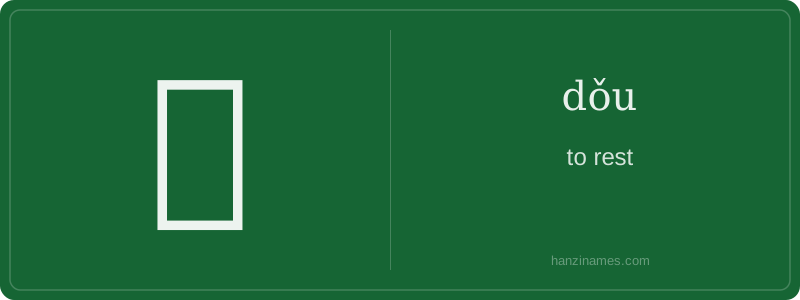
唞 is used almost exclusively in informal written Cantonese—especially in Hong Kong—to mean 'to take a break' or 'to rest'. It appears in social media, signage (e.g., '唞下先!' — 'Let’s rest a bit first!'), and colloquial dialogue. It is absent from formal education, government documents, and Mandarin-dominant contexts. No classical texts or historical records document its use before the late 20th century; it emerged organically as a local orthographic solution.
The character is not pictographic or ideographic in origin. It is a deliberate, modern borrowing of 斗 (dǒu), chosen solely for its approximate Cantonese pronunciation (/dau²/), not its meaning. Since 斗 has no semantic connection to resting, this illustrates how Cantonese writers pragmatically adapt existing characters for phonetic clarity—a practice long recognized in Chinese philology as 'phonetic loan' (jiǎjiè).
The character 唞 (dǒu) is not a standard modern Chinese character in the People’s Republic of China’s official character set (GB2312, GB18030, or Unicode CJK Unified Ideographs). It does not appear in authoritative dictionaries such as the Xiàndài Hànyǔ Cídiǎn (Contemporary Chinese Dictionary) or the Hànyǔ Dà Cídiǎn. Its inclusion in some Cantonese-specific lexical resources reflects regional linguistic adaptation—not classical etymology or nationwide usage.
This highlights a key aspect of the Chinese worldview: language is not monolithic but deeply contextual—shaped by geography, history, and community practice. What functions as a ‘character’ in Hong Kong or Macau may be absent in mainland textbooks, underscoring how meaning is co-created through lived use rather than fixed orthographic authority.
Importantly, 唞 is a phonetic loan character (jiǎjièzì), repurposed from the standard character 斗 (dǒu, meaning 'ladle' or 'unit of volume') to represent the Cantonese verb 'to rest'—pronounced /dau²/ in Jyutping. This pragmatic reassignment mirrors traditional Chinese approaches to writing: prioritizing sound and function over semantic fidelity when practical communication demands it.
Example Sentences
Common Compounds
Similar Characters — Don't Mix These Up
Your First Step into Chinese Culture: Get a Chinese Name
Every journey into Chinese begins with a name. Use our free Chinese name generator to create a meaningful, personalized Chinese name that fits you perfectly.
Get My Chinese Name →