唲
Character Story & Explanation
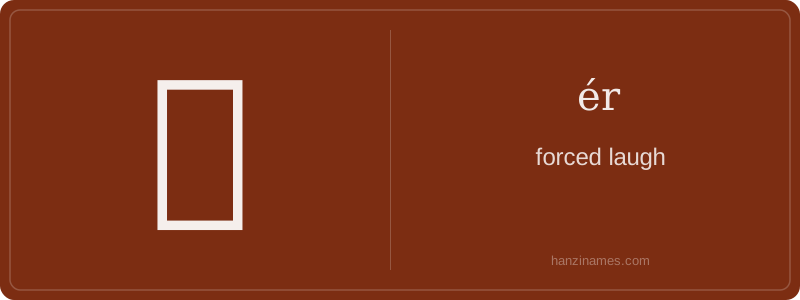
唲 appears in classical and early modern Chinese texts to denote insincere or socially coerced mirth. It features in Lu Xun’s 1925 essay 'Random Thoughts No. 36' (《随感录三十六》), where he critiques performative harmony in Confucian-influenced society, using 唲 to underscore hypocrisy masked as cheerfulness. Modern usage is almost exclusively literary or ironic—e.g., in contemporary essays mocking corporate 'smile training' or political stagecraft.
The character 唲 is a phonosemantic compound: the left radical 口 (kǒu, 'mouth') signals speech/voice; the right component 而 (ér) provides sound and hints at 'thus, therefore'—implying laughter that arises mechanically, not authentically. It first appears in Song dynasty rhyme dictionaries (e.g., 《集韵》), not oracle bones or bronze inscriptions, confirming its late, compositional origin.
The Chinese character 唲 (ér) is an archaic, literary term meaning 'forced or artificial laughter'—a smile not born of joy but of social obligation, irony, or discomfort. It conveys emotional dissonance: the mouth smiles while the heart remains unmoved. Unlike common laughter words like 笑 (xiào) or 哈哈 (hāhā), 唲 carries a subtle, almost melancholic undertone, often appearing in classical poetry and early 20th-century essays to critique performative civility.
This character is rarely used in spoken Mandarin today and does not appear in any HSK vocabulary list (HSK 1–9). Its near-total absence from modern textbooks and digital corpora reflects its status as a stylistic relic. When encountered, it’s typically in scholarly contexts—annotated editions of pre-1949 literature—or in deliberate, ironic revival by writers evoking historical voice or satirizing hollow politeness.
Western equivalents include English 'polite chuckle', 'nervous titter', or 'tight-lipped smile', but none capture 唲’s literary weight and lexical rarity. German ‘gezwungenes Lächeln’ or French ‘rire contraint’ are functional translations, yet lack the character’s classical resonance. Unlike English idioms like 'grin and bear it', 唲 is a single-character lexical unit—concise, evocative, and culturally specific to Chinese rhetorical traditions of restrained expression.
Example Sentences
Common Compounds
Similar Characters — Don't Mix These Up
Your First Step into Chinese Culture: Get a Chinese Name
Every journey into Chinese begins with a name. Use our free Chinese name generator to create a meaningful, personalized Chinese name that fits you perfectly.
Get My Chinese Name →