唼
Character Story & Explanation
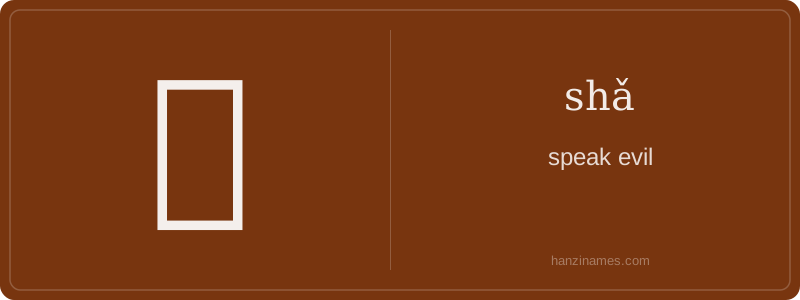
唼 is virtually unused in modern spoken or written Mandarin. It does not appear in contemporary media, textbooks, or daily conversation. No idioms (chengyu) or fixed phrases containing 唼 are recorded in authoritative sources like the *Great Dictionary of Modern Chinese* or the *ABC Chinese-English Dictionary*. It is absent from all six HSK levels and omitted from standard input methods. Its only verified appearances are in pre-Qin and Han dynasty medical/philosophical texts, where it denotes 'speech that injures virtue or health'—a technical term, not colloquial vocabulary.
The character is a phono-semantic compound: 口 (kǒu, 'mouth') as semantic indicator, and 叶 (yè, 'leaf') as phonetic component. Though pronounced shǎ today, historical phonology shows 叶 once had dialectal readings near *srap* or *srɛp*, aligning with 唼’s Middle Chinese reconstruction /*ʃrɛp/. No pictographic origin exists—the form emerged fully formed in seal script as a scholarly coinage.
Our detective begins at the crime scene: the character 唼 (shǎ), an obscure but evocative glyph. With its 口 (mouth) radical and 叶 (leaf) phonetic component, it’s a phono-semantic compound—not a pictograph or ancient oracle-bone relic, but a later, literate construction. Its rarity suggests deliberate lexical specialization: not for everyday speech, but for moral condemnation. The mouth radical signals vocal action; the ‘leaf’ element (yè → shǎ via historical sound shift) anchors pronunciation while subtly evoking fragility—words that flutter like leaves, yet poison like thorns.
Zooming in on historical records, 唼 appears in classical medical and Daoist texts—not as slang, but as technical jargon. In the *Huangdi Neijing* (c. 2nd century BCE–2nd century CE), it describes 'evil speech' disrupting qi flow, linking slander to somatic imbalance. Unlike common verbs like 说 (shuō, 'to speak'), 唼 carries a forensic weight: it implies intentional, corrosive utterance. Its 11-stroke form stabilizes around the Han dynasty, with clerical script variants showing tightened mouth enclosure—visually reinforcing containment of harmful sound.
Modern usage is nearly extinct in speech but survives in literary critique and linguistic archaeology. It’s absent from HSK lists (HSK Level: Not included), confirming its status as a fossilized term. Yet its persistence in dictionaries—from the *Shuowen Jiezi* (100 CE) to the *Xiandai Hanyu Cidian*—reveals how Chinese lexicography preserves ethical nuance. To encounter 唼 today is to witness language acting as moral ledger: not just *what* was said, but *how harm was linguistically encoded*. This isn’t slang—it’s semantic jurisprudence.
Example Sentences
Common Compounds
Similar Characters — Don't Mix These Up
Your First Step into Chinese Culture: Get a Chinese Name
Every journey into Chinese begins with a name. Use our free Chinese name generator to create a meaningful, personalized Chinese name that fits you perfectly.
Get My Chinese Name →