啄
Character Story & Explanation
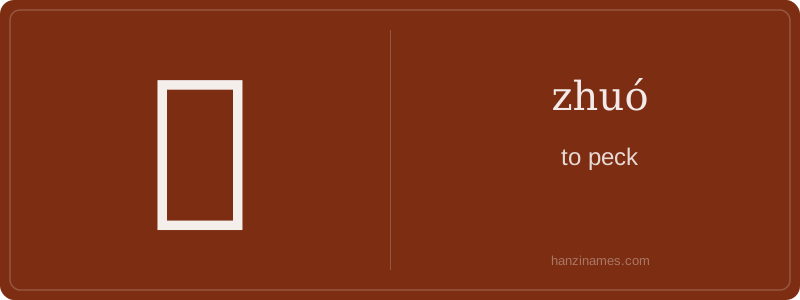
啄 is commonly used in modern Chinese in ornithological descriptions, children’s literature, and idioms like 鸟尽弓藏,兔死狗烹 (though 啄 itself doesn’t appear there, it features in related phrases such as 啄木鸟—woodpecker—and in the idiom 啄粟不休, meaning 'pecking grain incessantly', used metaphorically for persistent but small-scale effort). It appears in official biological terminology (e.g., 啄食行为, 'pecking feeding behavior') and primary-school science textbooks across mainland China.
The character is a phono-semantic compound: 口 (mouth) indicates the category of oral action, and 卓 (zhuó) serves as the phonetic component. While not a pictograph, its form stabilized during the Han dynasty seal script era; archaeological inscriptions (e.g., Shuowen Jiezi, 100 CE) confirm its early use for avian feeding actions—no oracle bone or bronze script forms survive, but Han bamboo slips document 啄 in agricultural records describing poultry behavior.
The Chinese character 啄 (zhuó) vividly captures the precise, rapid motion of a bird’s beak striking food or surface. Its structure—featuring the mouth radical 口 on the left and the phonetic component 卓 (zhuó, meaning 'outstanding' or 'lofty') on the right—reflects both semantic and phonetic logic: the 'mouth' suggests oral action, while 卓 provides pronunciation and subtly evokes the upright, decisive gesture of pecking. This duality is typical of phono-semantic compound characters in modern Chinese script.
Unlike English verbs like 'peck', which carry neutral or even playful connotations (e.g., 'peck at lunch'), 啄 often appears in literary, zoological, or idiomatic contexts with subtle intensity—it implies purposeful, repeated, sometimes forceful contact. In classical poetry, 啄 frequently describes sparrows or magpies interacting with human environments, lending a rhythmic, almost percussive quality to imagery. Its usage rarely extends metaphorically to humans without poetic license.
In Western culture, 'pecking' may evoke casual affection ('a peck on the cheek') or hierarchy ('pecking order'). But 啄 carries no romantic or sociological baggage—it remains firmly avian and literal. This linguistic precision reflects traditional Chinese observational focus on natural behavior as distinct from anthropomorphic projection. Consequently, 啄 appears in scientific texts (e.g., ornithology), classical allusions, and fixed expressions—but almost never in slang or informal speech about people.
Example Sentences
Common Compounds
Similar Characters — Don't Mix These Up
Your First Step into Chinese Culture: Get a Chinese Name
Every journey into Chinese begins with a name. Use our free Chinese name generator to create a meaningful, personalized Chinese name that fits you perfectly.
Get My Chinese Name →