啱
Character Story & Explanation
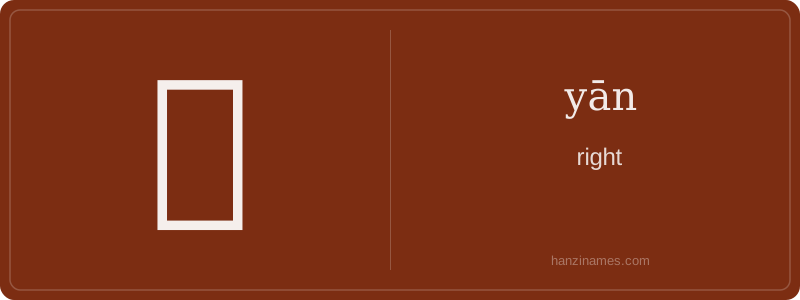
啱 is widely used in Hong Kong and Guangdong in informal writing—text messages, social media, advertisements, and subtitles—to represent the Cantonese word /ŋaːm˥/ meaning 'right', 'okay', or 'just right'. It appears frequently in phrases like '啱晒' (yān saai³, 'absolutely right') and '啱key' (Cantonese-English blend for 'perfectly matched'). It is absent from formal education, dictionaries like the Xiandai Hanyu Cidian, and all HSK exams.
The character 啱 has no ancient origin—it is a modern phonetic-loan character (jiajiezi), likely derived by adding the 口 (mouth/speech) radical to the phonetic component 崖 (yá, 'cliff'), adapting it to approximate the Cantonese pronunciation /ŋaːm˥/. Its shape was standardized informally in the 20th century; no oracle bone or seal script forms exist. Today, a Hong Kong teenager texting '呢個方案好啱' ('This plan is very right') embodies its living, vernacular function.
The character 啱 (yān) is not a standard Mandarin Chinese character—it does not appear in the People’s Republic of China’s official character lists, the GB2312 or GB18030 standards, nor in the HSK vocabulary. It is a Cantonese-specific written form used almost exclusively in informal contexts like chat messages, signage in Guangdong and Hong Kong, and colloquial literature. Its existence reflects the linguistic reality that Chinese is not monolithic: regional varieties maintain distinct orthographic conventions even when sharing the same spoken root.
This highlights a core aspect of the Chinese worldview—unity through diversity. While Standard Mandarin serves as the national lingua franca for education and governance, local languages like Cantonese are deeply tied to identity, heritage, and everyday authenticity. Using 啱 instead of the Mandarin-standard 对 (duì) or 正确 (zhèngquè) is an act of cultural affirmation—not resistance, but rootedness.
Importantly, 啱 carries pragmatic, interpersonal nuance beyond mere logical ‘correctness’. It implies alignment with shared understanding, social appropriateness, or contextual fit—e.g., ‘That timing is 啱’ means ‘That’s just right’, blending accuracy, timing, and relational harmony. This mirrors the Confucian emphasis on situational virtue (yi 義) over rigid rule-following—a ‘correct’ action must resonate with context, relationship, and intention.
Example Sentences
Common Compounds
Similar Characters — Don't Mix These Up
Your First Step into Chinese Culture: Get a Chinese Name
Every journey into Chinese begins with a name. Use our free Chinese name generator to create a meaningful, personalized Chinese name that fits you perfectly.
Get My Chinese Name →