啵
Character Story & Explanation
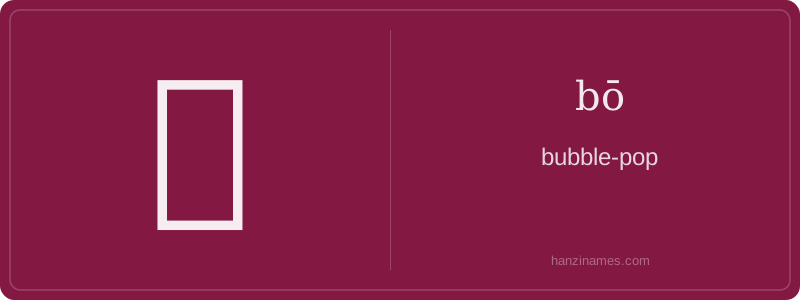
啵 is primarily used today as an informal sentence-final particle in Southern Mandarin dialects (especially Sichuanese and Hunanese) and in colloquial Mandarin speech, conveying mild persuasion, gentle insistence, or affectionate encouragement—e.g., '快走啵!' ('Let’s go already!'). It appears frequently in regional literature, film subtitles, and social media to evoke authenticity and warmth. Historically, it’s documented in Qing-era vernacular fiction and modern dialect dictionaries (e.g., *Sichuan Dialect Dictionary*, 1987) as a tonal variant of '吧' (ba), not a classical literary character.
The character 啵 has no ancient pictographic origin—it’s a later phonetic creation combining 口 (mouth, indicating speech/sound) with 波 (bō, 'wave', serving as phonetic support). Its form was standardized in the 20th century for representing this specific colloquial pronunciation, reflecting how modern Chinese orthography adapts to capture spoken nuance rather than reconstructing antiquity.
The character 啵 (bō) is a phonetic-ideographic compound rooted in the 'mouth' radical 口—signifying vocalization, sound, or oral expression. Unlike many Chinese characters tied to concrete objects or abstract virtues, 啵 captures a transient auditory phenomenon: the soft, rhythmic pop of bubbles. This reflects a distinctly Chinese linguistic sensibility—attuning language to the textures of lived experience, where even fleeting natural sounds earn lexical space. Its existence affirms that meaning isn’t only in nouns or verbs of action, but in onomatopoeic resonance and sensory immediacy.
In classical and modern Chinese alike, characters like 啵 embody the Daoist-inflected worldview that values spontaneity, fluidity, and the poetry of impermanence. Bubbling water—whether in a teakettle, hot spring, or rice wine fermenting in a jar—is not just physics; it’s qi in motion, life breathing audibly. 啵 thus encodes cultural attention to micro-moments of transformation: liquid becoming vapor, stillness giving way to effervescence, silence punctuated by gentle release.
Crucially, 啵 rarely stands alone as a lexical verb meaning 'to bubble' in formal writing—it thrives in spoken registers, dialects, and expressive reduplication. Its vitality lies not in dictionary definitions but in intonation: added to sentence endings for light-hearted emphasis or rhetorical softening (e.g., ‘好啵’), it transforms declaratives into warm, communal utterances. This mirrors the Confucian ideal of harmony—language as relational glue, not just information conduit. In 啵, we hear Chinese philosophy made audible: gentle, rhythmic, and deeply human.
Example Sentences
Common Compounds
Similar Characters — Don't Mix These Up
Your First Step into Chinese Culture: Get a Chinese Name
Every journey into Chinese begins with a name. Use our free Chinese name generator to create a meaningful, personalized Chinese name that fits you perfectly.
Get My Chinese Name →