啾
Character Story & Explanation
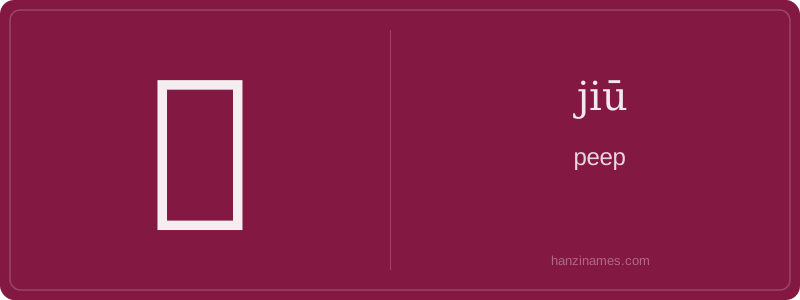
啾 is rarely used alone in modern Standard Mandarin; it almost always appears reduplicated as 啾啾 (jiūjiū) in spoken and written language. It’s common in children’s books, nature documentaries, and poetic descriptions — e.g., ‘鸟儿在枝头啾啾叫’ (birds chirping on branches). It appears in the classical text *Shuōwén Jiězì* (121 CE) as a ‘sound of small birds’, confirming its ancient onomatopoeic function. No idioms feature 啾 prominently, but it’s frequent in fixed expressions like 啾啾鸟鸣 (jiūjiū niǎo míng, 'twittering bird calls').
The character is not pictographic: its form combines 口 (mouth, indicating sound) and 秋 (qiū, serving purely as a phonetic component — no seasonal meaning here). The earliest attested use is in Han dynasty bamboo slips describing bird sounds. Today, Chinese parents may mimic 啾啾 playfully when cooing at babies — not as literal ‘wailing’, but as affectionate, rhythmic vocal play echoing infant gurgles and nestling calls.
The Chinese character 啾 (jiū) is an onomatopoeic glyph representing a high-pitched, repetitive sound — most commonly the chirping of birds, though historically and contextually it can also evoke the thin, plaintive wail of an infant. Its radical 口 (mouth) signals its connection to vocalization, while the phonetic component 秋 (qiū, 'autumn') hints at pronunciation but not meaning. Unlike English 'wail' or 'cry', 啾 carries a softer, more rhythmic, almost musical connotation — closer to 'peep' or 'cheep' than anguished sobbing.
In Western cultures, infant crying is rarely lexicalized with dedicated onomatopoeia in formal vocabulary; English uses descriptive phrases ('fussy cry', 'colicky wail') or generic verbs ('whimper', 'squeal'). By contrast, 啾 uniquely straddles avian and infantile sounds in Chinese — reflecting a linguistic tendency to group high-frequency, rhythmic vocalizations under one expressive syllable. This blurring mirrors how Japanese uses ぴょん (pyon) for both a hop and a spark, prioritizing acoustic texture over semantic precision.
While 啾 is not HSK-listed (it appears only in literary, poetic, or dialectal contexts), it’s widely recognized due to its vivid sonic quality. It appears in classical poetry (e.g., Tang dynasty verses evoking springtime birdsong) and modern children’s literature, where its repetition (e.g., 啾啾) mimics the cadence of baby babble or nestling calls. Culturally, it avoids negative associations — unlike English ‘screech’ or ‘shriek’, 啾 suggests innocence, fragility, and natural rhythm rather than distress or alarm.
Example Sentences
Common Compounds
Similar Characters — Don't Mix These Up
Your First Step into Chinese Culture: Get a Chinese Name
Every journey into Chinese begins with a name. Use our free Chinese name generator to create a meaningful, personalized Chinese name that fits you perfectly.
Get My Chinese Name →