喏
Character Story & Explanation
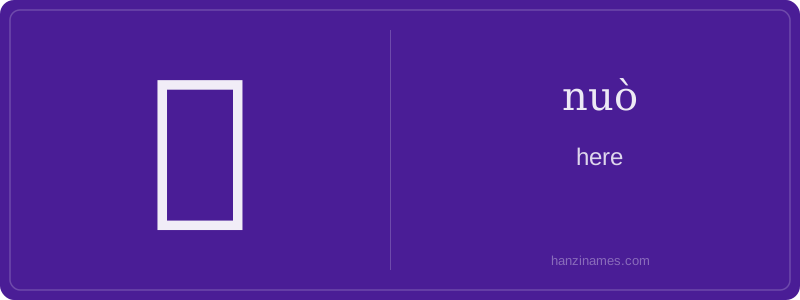
喏 is predominantly used in spoken Mandarin as a discourse particle to introduce or point to something visible or just mentioned—e.g., '喏,你的书!' ('Here—your book!'). It appears in classical novels like Water Margin and modern regional storytelling traditions, especially in northern dialects and Beijing opera narration. Though absent from HSK lists, it's documented in the Xiandai Hanyu Cidian (7th ed.) as an interjection with demonstrative force.
The character has no pictographic origin—it evolved phonetically from 若 (ruò) plus 口 (kǒu), reflecting its spoken function. Unlike ancient characters carved on bones, 喏 emerged later in manuscript culture as a way to transcribe vocal emphasis. Today, elders use it when handing objects, teachers when gesturing to diagrams, and narrators before revealing plot points—always with a slight upward inflection and open-palm gesture.
Our detective begins at the scene: the character 喏 appears in classical and vernacular texts not as a standalone word, but as a grammatical particle—a vocalized gesture. Its radical 口 (mouth) signals its oral nature: it’s spoken, not written for meaning alone. The right side 若 (ruò) originally meant 'like' or 'as if', but here it functions phonetically—guiding pronunciation toward nuò or rě. This is classic Chinese character logic: form follows sound and function, not literal imagery.
Historically, 喏 rarely stood alone in ancient inscriptions. It emerges strongly in Ming and Qing dynasty vernacular fiction—especially in dialogue tags like '喏,这便是…' ('Behold, this is…'), where it serves as a deictic marker, drawing attention like an extended finger. Think of it as linguistic stage direction: not 'yes' in the sense of agreement, but 'yes, *here*—look!' Its tone (fourth tone nuò) carries finality and presentation, not affirmation.
Modern usage confirms this forensic insight: 喏 is nearly extinct in formal writing but thrives in performative speech—storytelling, opera narration, or elder-led instruction. It’s the verbal equivalent of tapping the table twice: a rhythmic, emphatic pivot. Crucially, it’s never used to answer 'Do you agree?'—that’s 是 (shì) or 对 (duì). Instead, 喏 says: 'Pay attention—what follows is the thing itself.' Its survival lies in its theatrical utility, not semantic weight.
Example Sentences
Common Compounds
Similar Characters — Don't Mix These Up
Your First Step into Chinese Culture: Get a Chinese Name
Every journey into Chinese begins with a name. Use our free Chinese name generator to create a meaningful, personalized Chinese name that fits you perfectly.
Get My Chinese Name →