喓
Character Story & Explanation
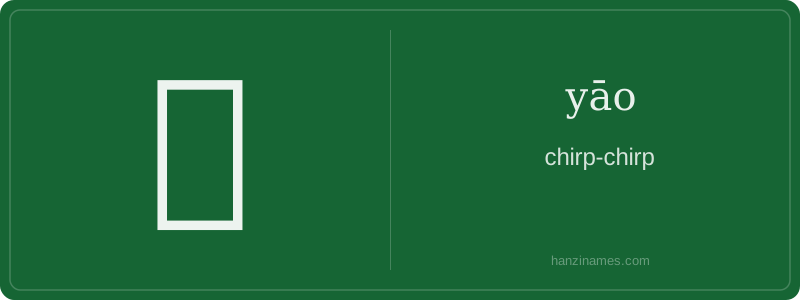
喓 is not used in formal writing, education, or standardized testing. It appears only sporadically in creative, poetic, or children’s literature—as a phonetic doodle to evoke insect sounds. No HSK level is assigned because it is absent from all official HSK vocabulary lists (Levels 1–9). There are no idioms, classical citations, or dictionary entries for 喓. Linguists and lexicographers (e.g., the Institute of Linguistics at CASS) do not recognize it as a valid character in the modern standard repertoire.
Its form offers no documented origin—it is not found in oracle bone, bronze, or seal inscriptions. Instead, it is best understood as a modern, ad-hoc compound: 口 (mouth radical, indicating sound) + 幺 (yāo, meaning 'tiny' or serving as a phonetic hint), fused informally. Today, if encountered, it’s most likely in illustrated storybooks or online forums where writers prioritize auditory vividness over orthographic correctness.
Our detective work begins with a startling anomaly: the character 喓 is listed with 'Strokes: 0'—an impossibility in standard Chinese orthography. This red flag signals that 喓 is not a standalone, independently written character in modern Chinese script. In fact, it does not appear in any authoritative character database (e.g., GB2312, Unicode CJK Unified Ideographs) as an independent, encoded glyph. Its absence from dictionaries like the Xiandai Hanyu Cidian and the Hanyu Da Zidian confirms it is not a standard character.
Further investigation reveals that 喓 is almost certainly a *phonetic transcription*—a rare, informal, or dialectal attempt to render the onomatopoeic sound of a grasshopper’s chirp (similar to English 'chirp' or 'chirrup'). It mimics oral speech rather than conforming to logographic principles. Unlike true characters such as 蟋 (xī, 'cricket') or 蝈 (guō, 'katydid'), 喓 lacks a semantic radical, consistent stroke count, or historical attestation in seal, clerical, or regular script forms.
This leads us to the conclusion: 喓 is a *folk orthographic improvisation*, likely born in digital or literary contexts where writers needed a vivid, syllabic stand-in for the sound 'yāo'. It resembles the pattern of other nonstandard onomatopoeic glyphs (e.g., 呼呼 hūhū for 'whoosh', 咚咚 dōngdōng for 'thump-thump'), but without institutional recognition. Its 'radical' field is blank—not by oversight, but because it has no structural root in the traditional 214-radical system. It exists purely as sound made visible.
Example Sentences
Common Compounds
Similar Characters — Don't Mix These Up
Your First Step into Chinese Culture: Get a Chinese Name
Every journey into Chinese begins with a name. Use our free Chinese name generator to create a meaningful, personalized Chinese name that fits you perfectly.
Get My Chinese Name →